(214) 272-7034
  info@fasthippomedia.com



TL;DR
HIPAA governs patient data, not your marketing website. No federal program certifies “HIPAA-compliant hosting,” and a June 2024 federal ruling vacated the guidance that scared practices away from analytics. Systems that touch PHI need a signed BAA and real safeguards; a brochure site usually needs neither. The larger risk for most practices is invisibility, because patients now find providers through AI answers, voice, and local search.
How Fear-Based Marketing Advice Is Quietly Killing Medical Practice Growth
A straight-talking guide for dermatologists, plastic surgeons, orthodontists, and every practice owner who’s been told, “You can’t do that. HIPAA.”
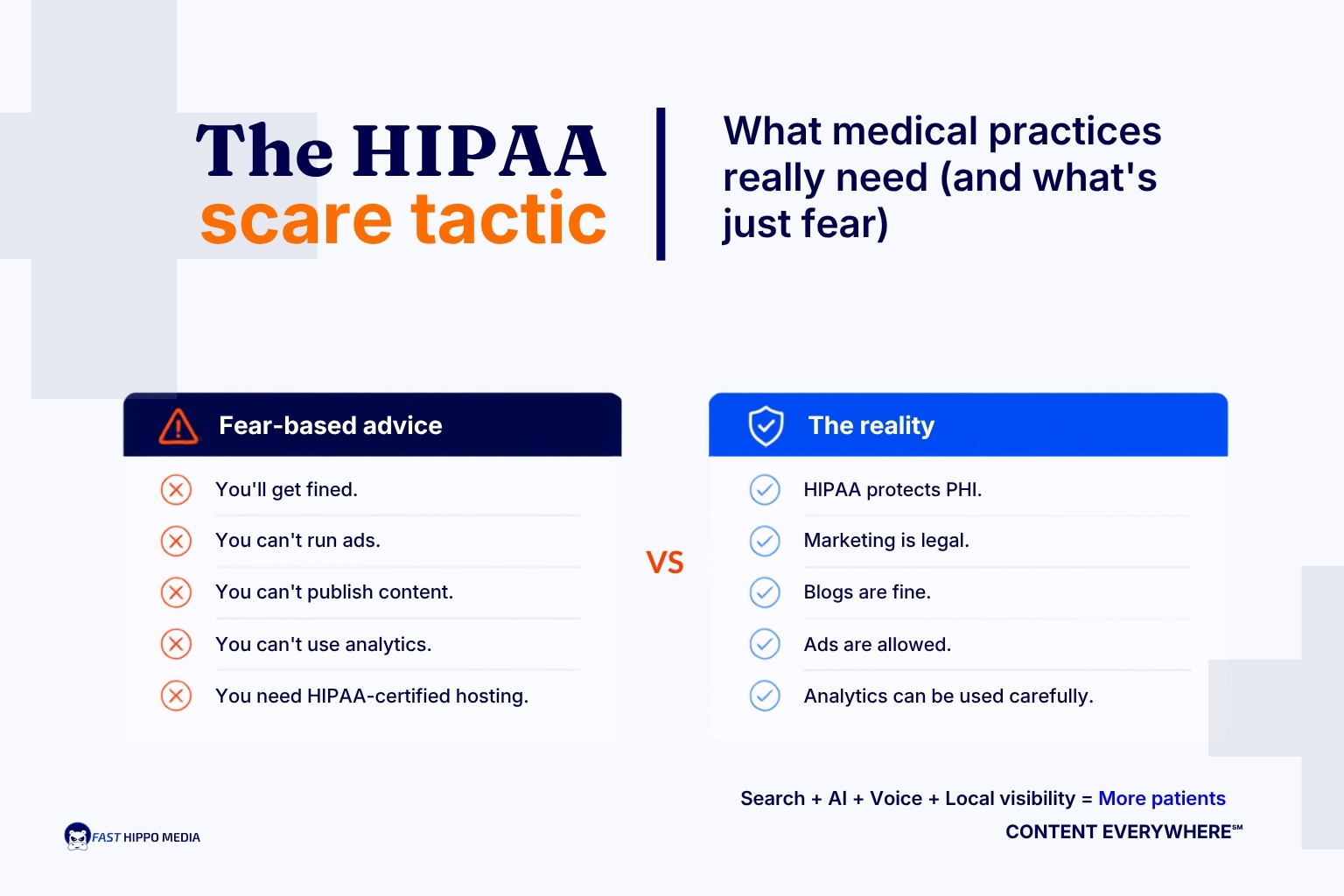
Too many digital marketing agencies and web hosts use HIPAA as a scare tactic. They convince dermatologists, plastic surgeons, orthodontists, and other practice owners that they can’t run real marketing, can’t use analytics, and must pay a premium for HIPAA-compliant hosting they don’t need. Most of that is fear, not law. HIPAA only governs protected health information (PHI), not your public marketing website, your blog, or your brand. While practices sit paralyzed by manufactured compliance anxiety, the real emergency is invisibility. , healthcare is among the verticals where AI answers appear most often, and patients increasingly find providers through AI assistants and voice search. The practices winning in 2026 aren’t the ones with the most locked-down websites. They’re the ones showing up in the answers.
The Fear Sale: What’s Really Going On
Here’s a conversation that happens in medical practices every week. A dermatologist wants to publish patient-friendly blog content, run a retargeting campaign, and finally fix the website that hasn’t been touched since 2019. An agency or hosting vendor leans across the table and says some version of this: “You can’t do that. You’re a medical practice. HIPAA. You’ll get fined. You need our special compliant hosting, our special compliant forms, and you really shouldn’t be running analytics or ads at all.” The doctor, who went to medical school and not law school, hears “fines” and “HIPAA” in the same sentence and shuts the conversation down. The marketing budget gets redirected to a $400-a-month “HIPAA-certified” hosting plan for a website that collects nothing more sensitive than a name and an email. The blog never launches. The competitor down the street, meanwhile, is getting cited by ChatGPT and showing up first in the local map pack. This is the fear sale, and it’s everywhere in medical marketing. Sometimes it comes from vendors who genuinely don’t understand the regulation. More often, it comes from vendors who’ve figured out that fear is a fantastic way to upsell hosting packages, lock clients into restrictive contracts, and avoid the harder work of producing marketing that performs. “Compliance” becomes the excuse for doing nothing, and the practice pays for the privilege of falling behind. Let’s be clear about what this guide is and isn’t. HIPAA is real. The penalties are real. There are absolutely places in healthcare marketing where you must be careful, and we’ll name every one of them. But “be careful in specific places” is a very different message than “be afraid of everything,” and the gap between those two messages is where a lot of practices are quietly losing.
What HIPAA Actually Says (and Doesn’t)
HIPAA, the Health Insurance Portability and Accountability Act, exists to protect protected health information (PHI): individually identifiable health information that a covered entity creates, receives, maintains, or transmits. That’s the whole game. HIPAA is triggered by PHI. No PHI, no HIPAA obligation. This single fact dismantles most of the fear. Your public marketing website, the one with your services, your team bios, your before-and-after gallery, and your blog about sunscreen or clear aligners, does not by itself contain PHI. A visitor reading about CoolSculpting is not a patient with a record. applies the rules to the parts of your operation that actually touch PHI. You don’t need to make your entire website “HIPAA compliant. “You need to make the specific parts that handle PHI compliant, and on most marketing sites that’s a small, contained piece, if it exists at all. Two more facts the fear-sellers leave out. First, there is no such thing as official “HIPAA-certified” hosting. that stamps a hosting provider as HIPAA-approved. Any vendor selling you “HIPAA-certified hosting” the way you’d buy a UL-listed appliance is, at best, using marketing shorthand and, at worst, manufacturing a credential that doesn’t exist. What HIPAA actually requires for systems that store electronic PHI (ePHI) is a signed (BAA) plus real safeguards: encryption, access controls, audit logging, and backups. That matters enormously for your patient portal or EHR. It has little bearing on a brochure website that collects nothing sensitive. Second, HIPAA explicitly permits you to market your own practice. Under the Privacy Rule, . A hospital can mail its patient list to announce a new specialty group or new equipment. Communications made for treatment, care coordination, or case management aren’t even classified as “marketing” under the rule and don’t require special authorization. HIPAA was never designed to stop you from promoting your practice. It was designed to stop you from selling patient data to third parties and blasting identifiable health information around without consent. Those are different things entirely. And in 2024, the legal ground shifted further in practices’ favor. On June 20, 2024, a federal court in the Northern District of Texas () vacated the most aggressive part of the government’s guidance on website tracking technologies. That guidance, the so-called “Proscribed Combination,” had treated a visitor’s IP address plus a visit to a health-related public webpage as protected health information. The court found the agency had overstepped its authority. The Office for Civil Rights filed an appeal that August and , which left the vacatur standing. In plain terms, the single scariest interpretation that agencies cited to tell you “you can’t use any analytics or pixels at all” was struck down. Worth being precise about the scope, because precision is the whole point of this article: the ruling vacated that one portion of the bulletin. The rest of the guidance still stands. The blanket version of the claim no longer reflects the law; a narrower version of it still does. None of this means anything goes. It means the rules are narrower, more specific, and far more workable than the fear sale implies.
Standard Hosting vs. HIPAA-Compliant Hosting: Which Do You Need?
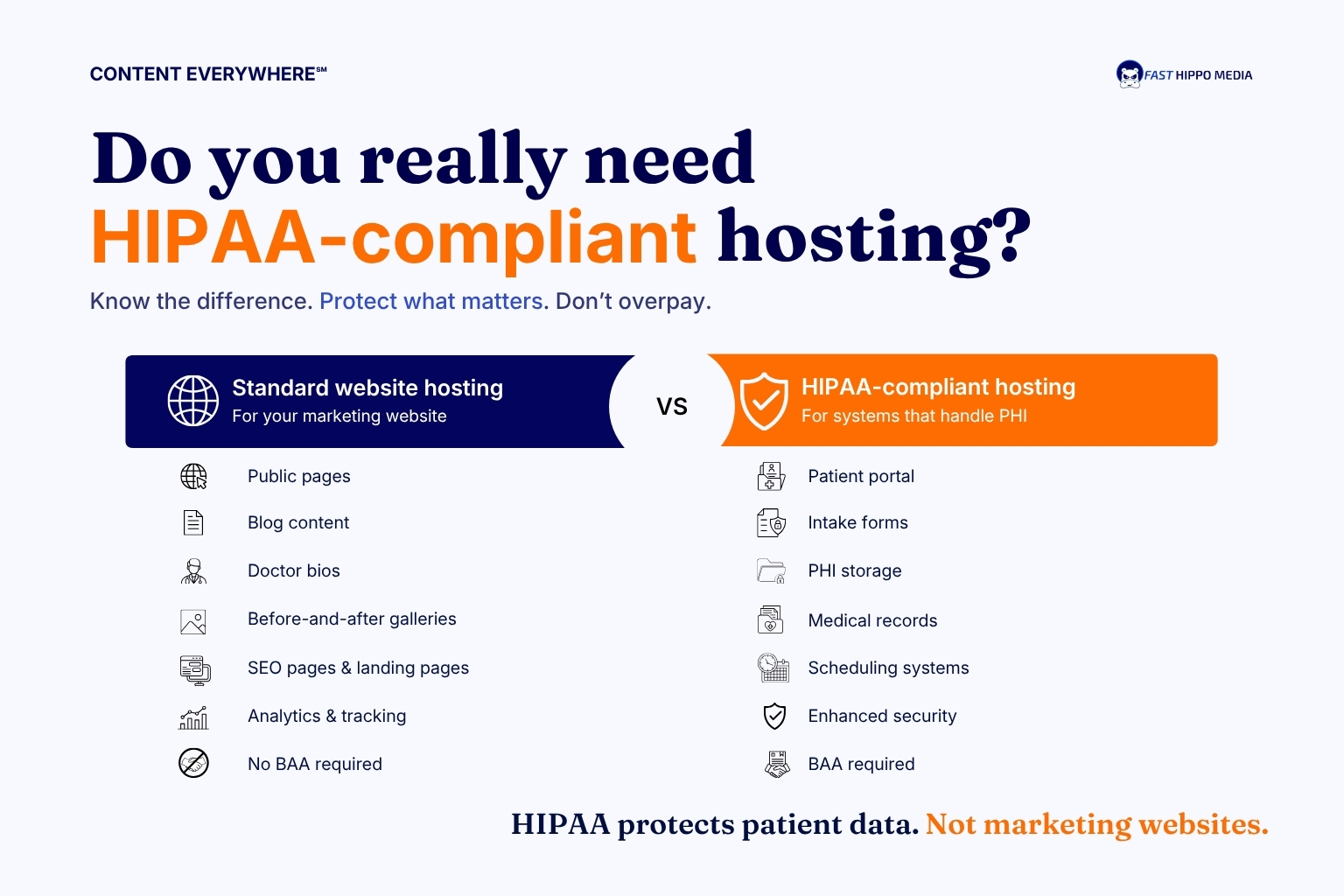
Most of the fear collapses once you see the two options side by side. One is for your public marketing presence. The other is for the narrow set of tools that handle patient data.
| Consideration | Standard Hosting | HIPAA-Compliant Hosting |
| Best suited for | Public marketing site: service pages, bios, blog, before-and-after gallery, general contact info | Systems that store or transmit PHI: patient portal, intake forms, scheduling with health details |
| BAA with host | Not offered. GoDaddy, Squarespace, Bluehost, and most standard hosts won’t sign one | Required. No BAA means no compliance the moment a patient record touches the server |
| Encryption | TLS in transit (standard) | At rest and in transit, to current standards |
| Access & audit logs | Basic login security | Role-based access plus tamper-evident logs of every action on PHI |
| Backups & recovery | Standard backups | Restorable without exposing PHI |
| Cost & speed | Lower cost, fast and easy to update | Premium cost, more locked down |
| Do most aesthetic or dental marketing sites need it? | Yes. This is what your public site should run on | Only for the components that touch PHI. Embed those; don’t rebuild the whole site |
Keep your marketing site on fast, standard hosting, and route only the PHI-collecting pieces (intake forms, patient portal) through a HIPAA-compliant, BAA-backed embed. Full HIPAA hosting for a brochure site is usually overkill. If your site also needs a rebuild to load fast and convert, that is a problem, not a compliance one.
The Five Myths Costing You Patients
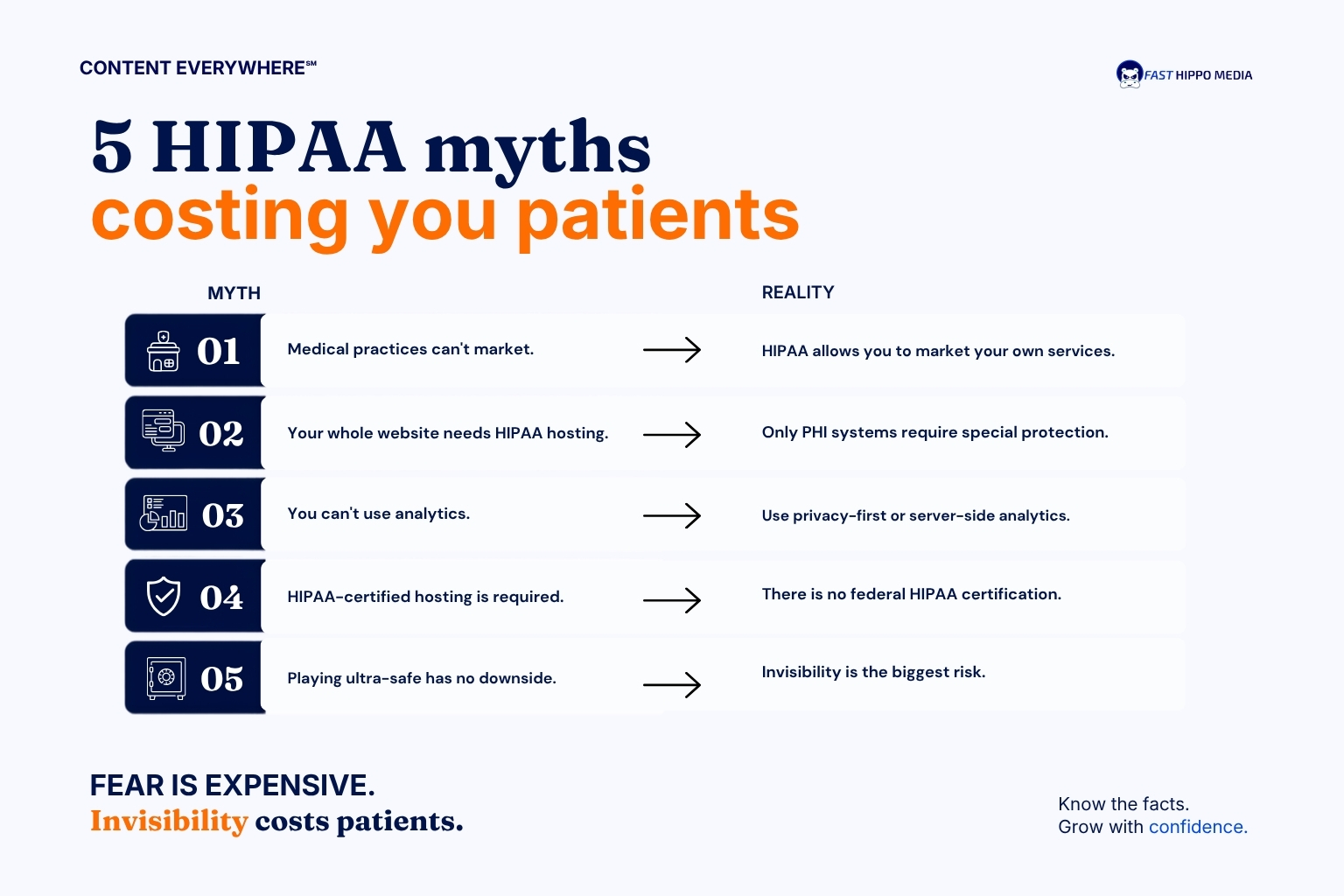
Myth 1: “Medical practices can’t really do digital marketing.” Reality: They can, and the law explicitly says so. Marketing your own services is permitted. The restrictions apply to using identifiable patient health data for promotion without authorization, not to running ads, publishing content, or building a strong brand.
Myth 2: “Your whole website has to be on special HIPAA hosting.” Reality: Only the parts that handle PHI need protected infrastructure. A marketing site that collects general contact information doesn’t transmit PHI in the HIPAA sense. If you do need to collect health details, embed a HIPAA-compliant form (with a BAA) for that one function and keep the rest of your site on standard, fast, modern hosting.
Myth 3: “You can’t use any analytics or tracking, ever.” Reality: This is the myth the directly undercut. The nuance that survives: be careful about placing tracking pixels on pages tied to specific conditions or treatments in ways that link an identifiable person to a sensitive health interest, and don’t use standard Google Analytics where it would capture PHI (Google won’t sign a BAA for it). But “be thoughtful about sensitive pages” is not “go dark entirely.” Privacy-respecting and server-side analytics options exist precisely for this.
Myth 4: “HIPAA-certified hosting is a requirement you can buy.” Reality: There’s no federal certification. A BAA plus genuine safeguards is what matters for ePHI systems. Paying a premium for a “certified” badge on a brochure site buys you a feeling, not compliance.
Myth 5: “Playing it ultra-safe has no downside.” Reality: This is the most expensive myth of all. Doing nothing feels safe and is costly. Every quarter a practice spends frozen by compliance anxiety is a quarter its competitors spend getting indexed, cited, reviewed, and found. The risk you can’t see on a compliance checklist, disappearing from the places patients now search, is the one draining your new-patient pipeline.
The Real Risk Nobody’s Selling You On: Invisibility
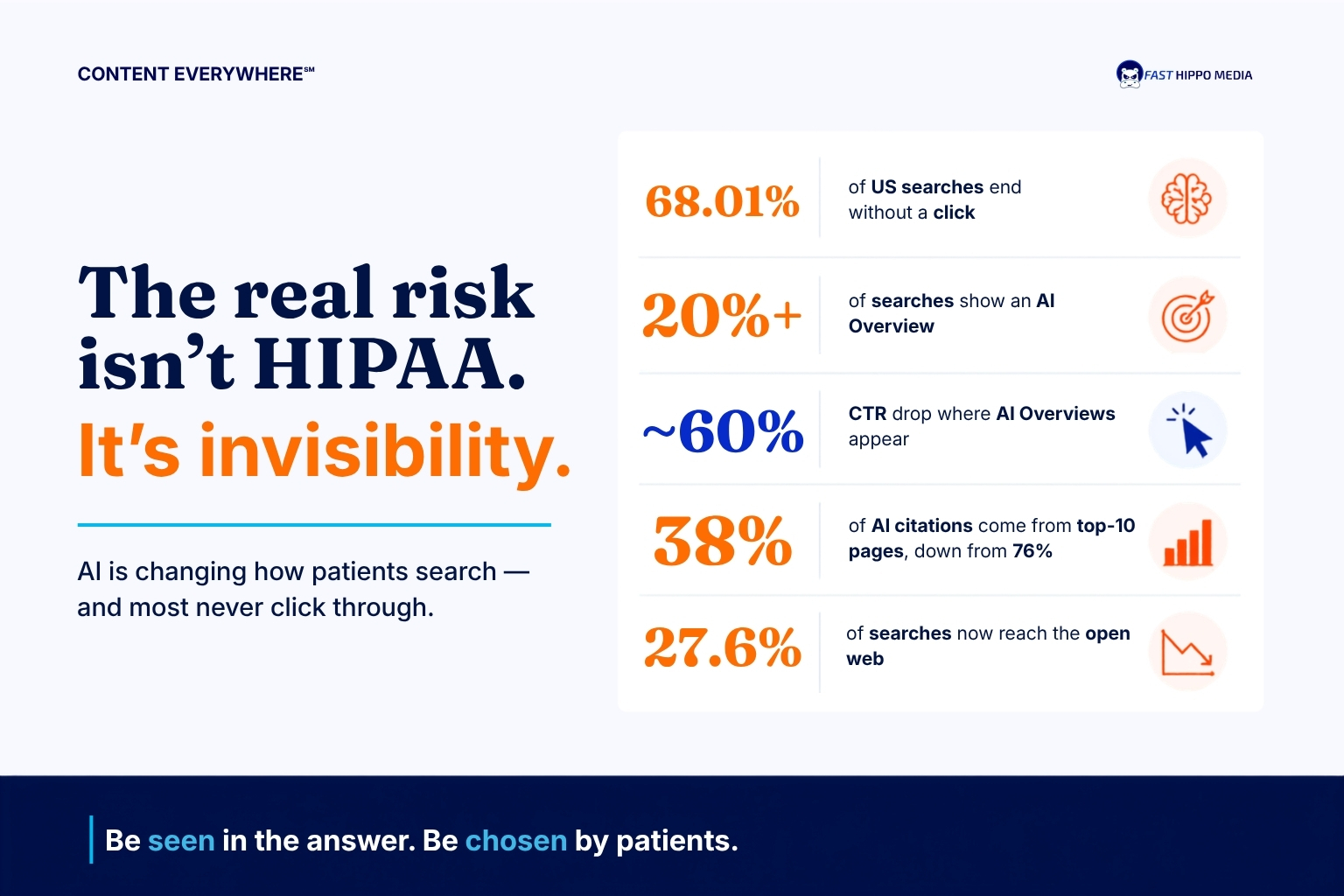
While practices have been frightened into inaction, the ground under healthcare search has shifted. The data heading into 2026 tells a blunt story.
- Most searches no longer produce a click: between January and April 2026, up from 60.45% two years earlier. Only 276 of every 1,000 searches now reach the open web at all.
- Where AI Overviews appear, clicks collapse: They now show on more than a fifth of all Google searches, and where they do, click-through rates fall by roughly 60%.
- Health topics are among the most exposed: Industry trackers consistently place healthcare in the highest tier for AI Overview coverage, though published estimates vary widely, from the low 40s to the high 80s in percentage terms. Treat the direction as reliable and the precise number as contested.
- Ranking no longer guarantees being cited: for that query, down from 76% earlier in the year. Roughly two in three citations come from pages a patient would never see on page one.
Read those numbers as a practice owner. The historical engine of new patient acquisition works like this: someone searches, sees your site, clicks, and books. That engine is being rerouted through AI answers and zero-click results. If your practice isn’t structured to be the answer, the visit never happens.
The good news sits in the same data. Local “near me” healthcare searches behave differently: Google still routes local provider searches toward the map pack, local listings, and organic results rather than summarising them away. The patient who searches “best plastic surgeon near me” or “Invisalign Frisco” is still clickable, provided you’ve done the work to show up. That is a problem with a known solution. The opportunity didn’t disappear. It moved.
AEO, GEO, and Voice: Where Patients Actually Find You Now
The discipline replacing old-school “rank #1 on Google” thinking has a few names, and practice owners should know them.
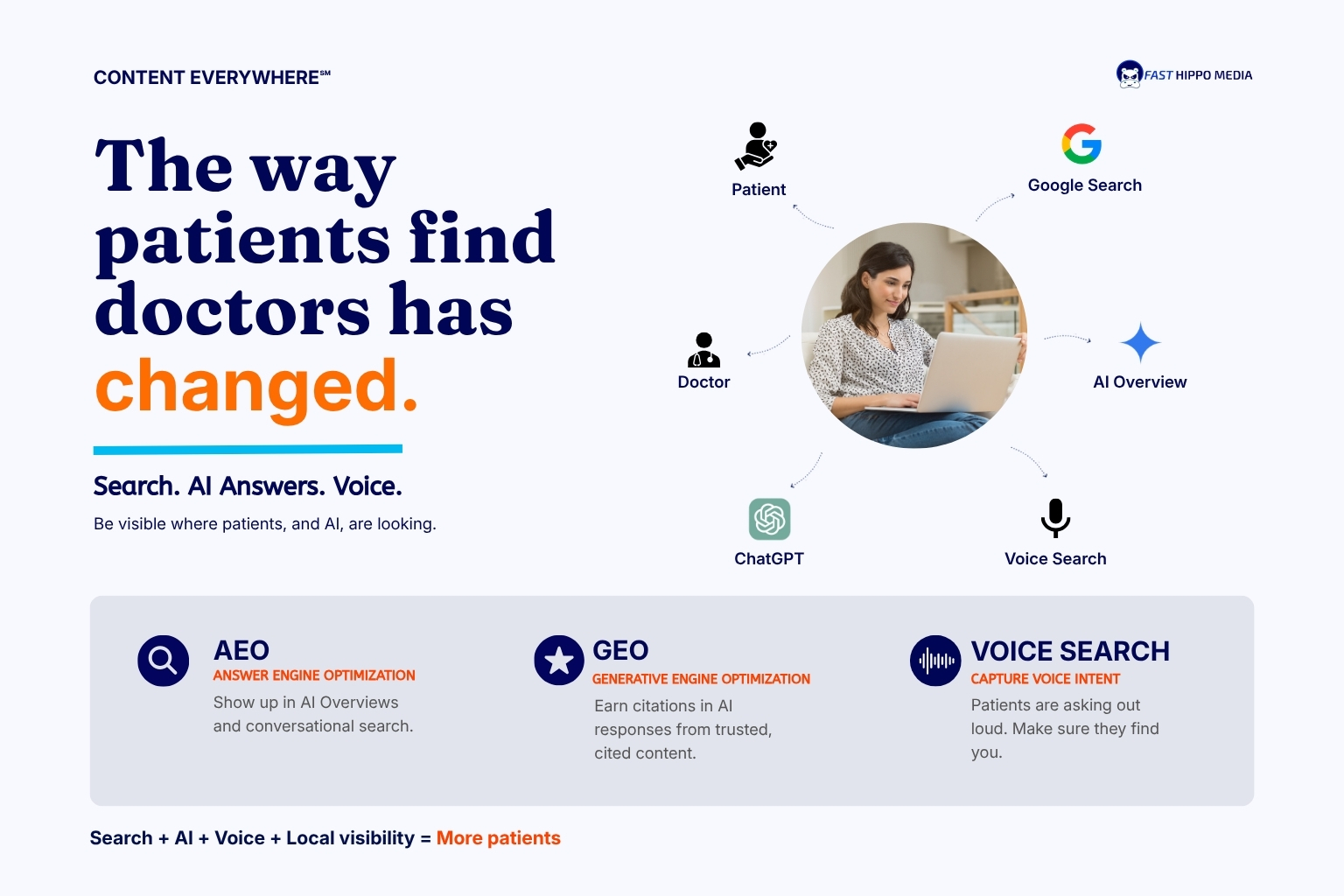
(AEO) is structuring your content so AI systems can extract a clean, authoritative answer and attribute it to you. Where traditional SEO optimized for click-throughs, AEO optimizes for being the cited source in the answer itself.
Generative Engine Optimization (GEO) extends that to the AI assistants patients now use directly: ChatGPT, Gemini, Perplexity, and Claude. The scale is the part practice owners underestimate. , having crossed 800 million only months before. That is a discovery surface most practices have no presence on whatsoever.
Voice search is the third front, and it skews local. US voice-assistant users are projected to reach roughly 157 million by the end of 2026, and about 76% of voice queries carry local “near me” intent. Voice is how a patient driving to work asks for “a pediatric dentist open on Saturdays nearby,” a high-intent, ready-to-book moment.
What ties AEO, GEO, and voice together is that they all reward the same things: clear, natural-language content that answers real questions; well-structured pages with FAQ-style headings and schema; authoritative provider profiles on directories like Healthgrades and Zocdoc; consistent reviews and reputation; and a fast, modern, well-organized website. None of that is blocked by HIPAA. All of it is blocked by a practice that’s been scared into standing still.
This is exactly the gap our methodology was built to close. It makes sure a practice’s expertise shows up across search, AI answers, voice, and the platforms patients use, instead of sitting trapped on a website nobody’s being routed to anymore.
What Compliant, Aggressive Marketing Actually Looks Like
You don’t have to choose between “compliant” and “competitive.” The practices doing this right are doing both. Here’s the shape of it.
They keep their fast, modern marketing website on standard high-performance hosting because it collects nothing that triggers HIPAA. When they do need to collect health information (an intake form or a consultation request with clinical detail), they route that single function through a HIPAA-compliant form or portal with a signed BAA and leave the rest of the site unencumbered.
They publish real content: patient-education articles, procedure explainers, and FAQ pages. That content is what AI engines cite and what voice assistants read aloud. They write it in natural language, structure it with question-based headings, and mark it up with schema so machines can parse it.
They mind the genuinely sensitive surfaces. They don’t drop a standard analytics tag or an ad pixel onto pages in a way that ties an identifiable individual to a specific condition. They use privacy-respecting, server-side, or BAA-backed measurement instead. That’s a targeted precaution, not a reason to abandon measurement.
They claim and optimize their and directory listings, gather reviews relentlessly, and respond publicly and professionally. Reviews carry more weight than most practices assume: found that 85% of consumers act on the reviews they read, with recency being the deciding factor. In cash-pay specialties, that gap between a current review profile and a stale one is often the whole decision. We walk through the mechanics of this in our guide to .And they treat compliance as a scoping exercise, not a paralysis trigger. The right question is never “Is marketing allowed?” It’s “where, specifically, does PHI enter this, and how do we protect that part?” That question has answers. Fear doesn’t.
A Practical Checklist for Practice Owners
Use this the next time a vendor tells you, “You can’t, because HIPAA.”
- Ask where PHI lives: If the answer is “it doesn’t,” the HIPAA objection doesn’t apply.
- Separate the marketing site from the PHI systems: Standard hosting for the brochure site; protected, BAA-backed infrastructure only where ePHI is stored or transmitted.
- Get a BAA for the things that genuinely need one: your portal, your intake forms, and your email PHI handling. Don’t pay for “certification” that doesn’t exist.
- Don’t go dark on measurement. Get smart about it: Keep sensitive condition and treatment pages clean of identity-linked tracking; use privacy-first or server-side analytics elsewhere.
- Invest the freed-up budget in being found: AEO-structured content, GEO visibility, voice and local optimization, reviews, and directory profiles.
- Ask any vendor to cite the specific rule: “HIPAA says so” is not a citation. A real compliance answer points to PHI, a BAA, or a specific safeguard. Fear points to nothing.
HIPAA is a scalpel, not a wall.
It cuts precisely around protected health information and leaves the vast majority of your marketing untouched. The agencies and hosts using it as a wall aren’t protecting you. They’re protecting their upsell and their own inertia. Meanwhile, patients are moving to AI answers, voice, and local search faster than ever. The practices that understand the difference are the ones that will own the next decade of patient acquisition.
Worried you’re playing defense when you should be playing offense? That’s exactly the trap this guide is about. If you’d like a clear-eyed read on where your practice is exposed and where you’ve simply been scared into standing still, we build compliant, aggressive visibility through our methodology. Let’s get your practice found in the answers.
This article is general information about marketing compliance, not legal advice. HIPAA obligations depend on your specific systems and data flows. Review your setup with your healthcare attorney before making changes.
Frequently Asked Questions
Not as a whole. HIPAA applies only to the parts of your operation that create, store, or transmit protected health information. A public marketing site with service pages, bios, a blog, and general contact information typically doesn’t handle PHI and isn’t subject to HIPAA’s hosting and security requirements. Only the specific components that collect or transmit health information, such as an intake form or patient portal, need protected, BAA-backed handling.
No. There is no official federal program that certifies a hosting provider as HIPAA compliant. What HIPAA requires for systems storing electronic PHI is a signed Business Associate Agreement plus genuine safeguards such as encryption, access controls, and audit logging. A certified badge on a brochure website that collects no PHI is marketing, not a legal mandate.
Yes. HIPAA explicitly permits covered entities to communicate about their own products and services, and communications for treatment or care coordination aren’t even classified as marketing. The restrictions apply to using identifiable patient health information for promotional purposes without authorization, not to advertising your practice or publishing educational content.
With care. Standard Google Analytics shouldn’t be used where it would capture PHI, because Google won’t sign a BAA for it. Identity-linked tracking pixels should also be avoided on pages tied to specific conditions or treatments. A 2024 federal court ruling vacated the government’s most aggressive tracking guidance, and privacy-respecting and server-side analytics options exist. The claim that practices can use no analytics at all overstates the law.
Answer Engine Optimization (AEO) is structuring your content so AI systems can extract and cite it as the authoritative answer to a patient’s question. It matters because most Google searches now end without a click, and health topics are among the categories where AI answers appear most often. If your practice isn’t optimized to be the answer, you lose visibility even when your information is the best available.
Yes, and the numbers are climbing. US voice-assistant users are projected to reach roughly 157 million by the end of 2026, and about 76% of voice queries carry local near-me intent. Patients are also using AI assistants like ChatGPT and Perplexity to generate provider shortlists before they ever open a traditional search engine.