(214) 272-7034
  info@fasthippomedia.com


Ecommerce SEO fails in predictable ways: products search engines cannot find, manufacturer descriptions repeated across every page, and traffic that arrives but does not buy. The fixes run in order: crawl health, structured data, rewritten pages for your highest-revenue products, then conversion structure. In 2026 there is a fourth layer, because buyers increasingly ask an assistant what to buy before they ever reach a results page.
Why ecommerce sites struggle with rankings and revenue
Almost always for one of three reasons, and they are worth separating because the fixes are different.
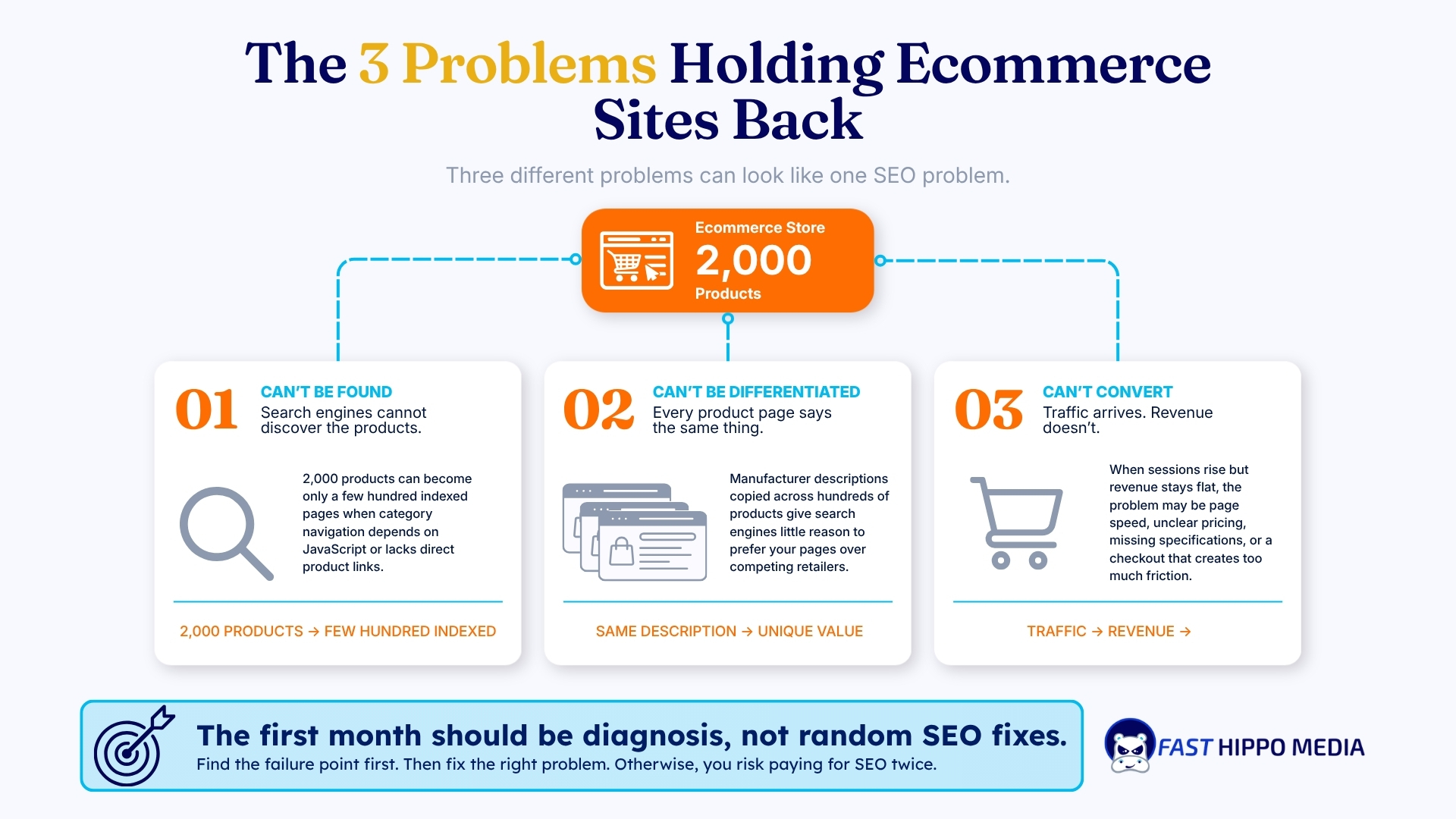
Search engines cannot find the products: A store with two thousand products and a category system built in JavaScript may have a few hundred pages actually indexed. Google is direct about this in its : “If category pages don’t include direct links to all products in a category, Googlebot might not find all of your products by crawling alone.” Nothing else on this list matters until that is fixed, because you cannot rank a page nobody has crawled.
Every product page says the same thing: Manufacturer descriptions pasted across a catalogue produce hundreds of pages with no reason to prefer any of them, and no reason for a search engine to prefer yours over the twelve other retailers using the identical text.
The traffic arrives and does not buy: This is the one that gets misdiagnosed as an SEO problem. If sessions are up and revenue is flat, the issue is usually further down: page speed, unclear pricing, missing specifications, or a checkout that asks for too much.
Diagnosing which of the three you actually have is the entire first month of a competent engagement. Skipping it is why so many stores have paid for SEO twice.
The fixes, in the order that works
The order matters more than the individual tactics, because each step makes the next one worth doing.
1. Make the catalogue crawlable
Start with what is indexed against what exists. If those two numbers are far apart, everything else waits.
The usual causes are faceted navigation generating infinite URL variations, category pages that paginate through JavaScript, and products reachable only through search. Google’s advice on this is unglamorous and specific: use ordinary links for navigation, and link to your best-selling products from your homepage or your content, because “the more links a page has to it within a site, the higher the relative importance of the page to other pages on your site.”
That last line is worth reading twice. Your internal linking is a priority signal you are already sending, whether or not you meant to.
2. Add complete structured data
Google’s puts the purpose plainly: “Structured data is a standardized machine-readable format for providing information about a page. This can improve the accuracy of Google’s understanding of your content.”
For a store that means Product markup on every product page, complete rather than partial. Most stores emit name, price and availability and stop, leaving brand, identifier and ratings empty. Google also recommends Review snippet markup, BreadcrumbList, Organization, and VideoObject where product video exists.
Two rules break more stores than anything else. Markup must match what a visitor can see, and it should be generated from your product data through the template rather than pasted per product, because pasted markup drifts the first time somebody edits a price. Which types still earn rich results and which quietly stopped is in our guide to .
3. Rewrite the pages that make the money
Not the whole catalogue. The ten to fifty products that generate most of your revenue.
This is the single most misunderstood decision in ecommerce SEO. A store that rewrites its top ten products properly, with real specifications, honest comparisons and answers to the questions buyers actually ask, will outperform a store that spreads the same budget across two thousand pages of lightly-reworded manufacturer copy. Coverage feels like progress. Depth produces it.
The same logic applies to publishing generally, and we went into why in .
4. Fix the conversion structure
Rankings are the input. Revenue per session is the score.
Once the right traffic arrives, the work moves to what happens next: load speed on mobile, specifications in text rather than in images, clear stock and delivery information, reviews visible on the page, and a checkout that does not ask for an account before it asks for money.
Where ecommerce SEO is heading: AI shopping surfaces
Google rankings are no longer the whole game, and this is the part most ecommerce SEO pages have not caught up with.
Shoppers now describe what they want to an assistant and get two or three products back with reasons attached. Google’s AI answers product questions above the results. On those surfaces there is no page two and no scrolling, so the gap between being named and not being named is total.
The stores winning there did the foundational work above first, then added two things: complete Product structured data on every page, and a product feed that meets OpenAI’s published specification, which includes a required field controlling whether a product can be surfaced in ChatGPT search at all. We covered the full playbook in our guide to .
It is also the first question worth asking any ecommerce SEO partner: what is your plan for the surfaces where nobody clicks? The discipline behind it is , and a store that has never heard the question is being optimized for last year.
How to choose an ecommerce SEO company
Five questions, and the answers tell you more than any proposal.
“Can you show me store results with timeframes and starting points?”
A percentage with no baseline and no period is decoration. “Traffic doubled” from what, over how long, doing what, and was the store growing anyway. If an agency cannot answer that about its own case studies, apply the same scepticism to everything else it tells you. This is a fair question to ask us too.
“Do you report in revenue or in rankings?”
Rankings are a means. A report full of position changes and no revenue line is measuring the wrong thing on purpose.
“What is your plan for AI shopping visibility?”
Covered above. This is the fastest way to find out whether you are buying a 2026 service or a 2019 one.
“What will you not do?”
A partner who will tell you which parts of your catalogue are not worth optimizing is thinking about your return rather than their scope.
“Who does the work?”
Ask specifically whether product page rewrites are done by somebody who will learn your products or generated in bulk. You will be able to tell from the output either way, but it is cheaper to ask first.
What good looks like, mechanically
Rather than quote outcomes, here is what the work actually consists of, because the mechanism is checkable and an outcome is not.
On a store with a crawling problem, the fix is structural: real links to category and product pages, faceted navigation controlled so it stops generating variants, a clean sitemap, and internal links pointing at the products that matter. The measurable change is indexed pages against total products, and it moves within weeks because it is a technical fix rather than an authority one.
On a store with duplicate descriptions, the fix is editorial and narrow: the highest-revenue products rewritten with real specifications and comparison points, and Product markup completed so the facts are stated rather than inferred. The measurable change is impressions on non-brand product queries.
On a store with traffic that does not convert, the fix is not SEO at all, and an honest partner will say so. It is speed, clarity and checkout. The measurable change is revenue per session, and it is the only one of the three where doing more SEO makes things worse rather than slower, because you are buying more traffic for a page that already fails the visitors it has.
Those three are different problems with different timelines, and the reason to separate them is that a plan addressing all three simultaneously is usually addressing none of them properly.
How to tell which one you have, in about an hour. Pull your indexed page count from Search Console and compare it against the number of products in your catalogue; a large gap is problem one. Take twenty product pages at random and check whether the descriptions are yours or the manufacturer’s; mostly manufacturer copy is problem two. Then look at revenue per session by traffic source. If organic sessions convert markedly worse than direct or paid, the traffic is arriving and failing, which is problem three.
Most stores find they have two of the three, and the order above still holds, because fixing conversion on pages nobody can reach produces nothing measurable.
Where local SEO fits
Only if you have physical locations, and then it matters more than most stores realise.
A retailer with stores serves two different searches: the national product query, and the person nearby who wants it today. The second is a local search problem, which means a complete Google Business Profile, accurate hours, and inventory information where you can provide it. Our work covers that side, and for a store with locations it frequently produces revenue faster than the national campaign does, because the intent is closer to purchase.
If you are purely online, skip this and put the effort into the catalogue.
Your first 90 days
Three phases, in order.
Weeks 1 to 4: find out what is actually wrong: Indexed pages against total products. How many product pages carry unique descriptions. What your revenue per session is and whether it moves by traffic source. Most stores discover the problem they have is not the problem they assumed.
Weeks 5 to 8: fix the foundation: Crawlability first, then complete Product structured data across the catalogue. Both are template-level work, which means they scale without per-product effort.
Weeks 9 to 12: go deep on the products that matter: Rewrite your top revenue drivers properly. Add the comparison content buyers look for. Check whether an assistant names any of your products when asked about your category, and note who it names instead.
If you would rather have that run for you, our work starts with the diagnosis rather than the proposal, and the first deliverable is usually a list of things not worth doing. The wider programme covers everything outside the store.
Frequently Asked Questions
It is the technical, content and authority work that makes an online store visible where buyers search: Google results, shopping surfaces and now AI recommendations. It matters because stores compete nationally by default, so visibility is the difference between a catalogue that sells and one nobody finds.
By fixing the funnel in order: technical health so products get indexed, product page content that matches what buyers actually search, and conversion structure so the traffic buys. Rankings are the input. Revenue per session is the score.
A technical audit, complete Product structured data, product and category page optimization, content answering buyer questions, review strategy, and reporting tied to revenue rather than rankings. In 2026 it should also include AI shopping visibility, which means machine-readable catalogues and product feeds.
Yes, by narrowing. A store that optimizes its ten highest-revenue products deeply will outperform one that spreads the same effort across the whole catalogue. Scope controls cost and focus controls results, which is why the first useful thing a partner can tell you is what not to bother with.
Ask for store results with timeframes and starting points, ask whether they report in revenue or rankings, and ask what their plan is for AI shopping visibility. If they cannot explain how products get recommended inside ChatGPT, they are optimizing for last year.
Technical fixes show up in weeks because indexing responds quickly. Product page rewrites show up over a few months. Authority and competitive rankings take longer and keep building. Anyone quoting a single timeline for all three is describing a sales process rather than the work.