 (214) 272-7034
  info@fasthippomedia.com


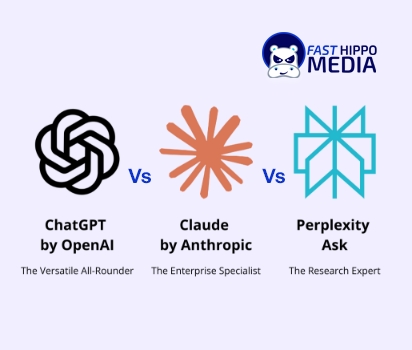
Getting cited by AI engines is a learnable discipline with documented mechanics. Five inputs drive citation: entity clarity across the open web, citation density in authoritative sources, question-form content with direct answers, structured data (especially FAQPage and Service schema), and topical depth. This piece breaks down each input in operational detail, with a 90-day playbook to start earning citations across all five major engines.
In 2024, “How do I rank in ChatGPT?” was a curiosity question. By mid-2026, it is one of the highest-stakes strategic questions a service business can ask. AI engines now produce the curated short lists that buyers shortlist from for an enormous range of high-value purchase decisions, including agencies, attorneys, financial advisors, medical specialists, contractors, restaurants, hotels, and B2B vendors. The business named in those short lists wins a disproportionate share; the business not named loses share quietly.
For a Frisco business specifically, the stakes are larger than national averages because Frisco’s demographic profile (median household income above $111,000 in 75034, professional and managerial workforce concentration, heavy Apple device penetration, the affluent gated communities of Starwood and the surrounding west-side master-planned communities, and the corporate B2B audience around the Cowboys Way campus at The Star) skews materially toward AI-search adoption. A Frisco Square law firm not cited when a Collin County resident asks Claude for representation is losing a pipeline that a generic Texas firm of similar size would not lose. A Stonebriar Centre retailer not surfaced in Gemini’s “best [category] near Frisco” answer is losing coverage and customers that did not exist as an AI surface 18 months ago.
The good news: the mechanics of getting cited are documented, learnable, and measurable. Below is a field-level playbook drawn from real engagements, real measurement, and real outcomes, not buzzwords. The examples throughout reference real Frisco, TX neighborhoods and search patterns because that is where our team operates from (Fast Hippo Media’s Frisco office at 7700 Preston Rd serves businesses across Frisco Square, The Star District, Stonebriar, and Starwood).
How AI engines actually decide who to cite
AI engines do not pick businesses in the way Google’s organic algorithm picks pages to rank. The decision process is different, and the inputs are different.
When a user prompts ChatGPT, Claude, Perplexity, Gemini, or Google AI Overview with a question like “what are the best [category] near [location]?” the engine performs an internal retrieval and synthesis: it pulls from its training data, from any real-time search results it has access to, from authoritative sources it has indexed, and from structured data it has parsed. It then synthesizes a short answer naming specific businesses or providers it has high confidence are authoritative.
The key insight: the engines are confidence-weighted. They cite businesses whose entity signals across the open web are consistent, authoritative, and machine-readable. Businesses with fragmented entity data, inconsistent NAP, no structured data, and thin citation density do not get cited even if they would rank organic position one for the same query.
Five inputs drive citation. Building each one is operational, measurable work.
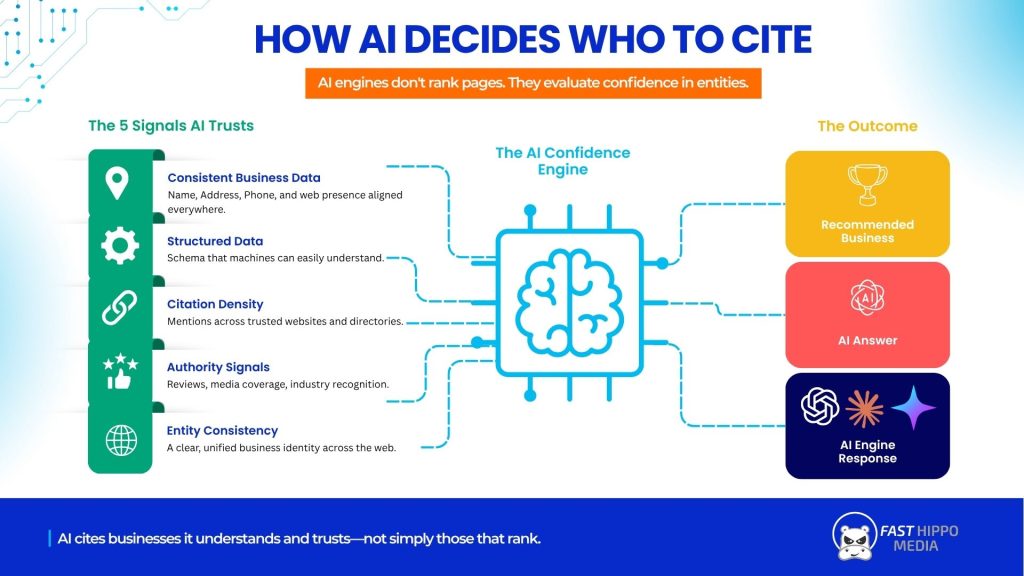
Input 1: entity clarity across the open web
AI engines need a clean, consistent entity to cite. Your business name, address, phone, category, services, and key descriptors should appear identically across Google Business Profile, Bing Places, Apple Maps, Yelp, Foursquare, industry directories, and the 60+ aggregators that feed every voice assistant.
NAP inconsistency is the most common entity-clarity failure. We routinely audit Frisco businesses with five different versions of their phone number, three different address formats, and conflicting category assignments across major directories. AI engines cannot confidently cite a business with that level of entity fragmentation.
The fix is mechanical but tedious: a comprehensive NAP cleanup, a single canonical entity definition deployed consistently, and an ongoing monitoring program to catch new inconsistencies as they appear. Most agencies under-invest in this work because it is unglamorous. The agencies that do it well unlock an AI engine citation that competitors with fragmented data cannot.
Input 2: citation density in authoritative sources
AI engines weigh citations from sources they treat as authoritative. The treatment varies engine to engine, but the high-trust source patterns are broadly consistent: industry trade publications, regional and local press (D Magazine, Frisco Style, Dallas Business Journal, Community Impact, Dallas Innovates), well-curated directories (BBB, Chamber of Commerce, industry-specific niche directories), and the searchable open web in general.
For Frisco businesses, the most leverage typically comes from regional press placements and category-specific trade outlets. A Frisco law firm cited in three regional publications and two legal trade journals will earn AI citations faster than a Frisco law firm with the same on-page work but no earned-media footprint.
Citation density is built through real PR work, pitching journalists, writing contributed expertise pieces, supporting category-specific narratives that journalists want to cover, and the long-cycle relationship work that turns one placement into a multi-year referral source. Link-buying schemes do not produce this; real PR does.
Input 3: question-form content with direct answers
AI engines prefer content that matches the structure of how their users actually ask questions. Full-sentence questions in H2 headers, followed by direct sub-60-word answer paragraphs, are the structure LLMs cite verbatim more often than any other format.
For most service businesses, the on-page rewrite is straightforward: identify the actual question queries your buyers use (drawn from People Also Ask data, AI engine response audits, autocomplete patterns, and customer call transcripts), restructure your top revenue pages around those questions as H2s, and ship direct answer paragraphs immediately beneath each question.
The before/after is dramatic. Pages that previously buried answers in narrative paragraphs become AI-citation candidates after restructuring without any change to the underlying content quality. The structure is what makes content machine-citable.
Input 4: structured data (FAQPage and Service schema)
Structured data is the machine-readable signal that confirms content structure to AI engines. Without it, the engines have to infer structure from layout, and the inference is imperfect. With it, the engines confirm the structure and weight appropriately.
For most service businesses, the schema priorities are FAQPage (markup every FAQ block on the site), Service schema (with explicit areaServed pointing to the specific geographic markets you serve), LocalBusiness with full NAP and aggregateRating, and BreadcrumbList for site hierarchy. Connect all entities via @id references so the engines parse them as one knowledge object.
Most Frisco businesses ship 2019-era schema (or none at all). The agencies running modern schema deployment unlock AI citation that competitors with thin or broken schema cannot access.
A 90-day rollout plan for earning AI citations
Days 1–14: Audit and entity foundation. NAP cleanup, GBP rebuild, schema audit. Document current AI Overview and LLM citation baseline across 25–50 question queries.
Days 15–45: Content and schema deployment. Rewrite top 10–20 revenue pages around question-form H2s with direct answers. Deploy the FAQPage schema. Build out Service entries with explicit areas served. Connect all schemas via @id references.
Days 46–75: Citation building. Pitch 5–10 PR placements in regional press and category-specific trade outlets. Earn at least 2–4 published placements. Update high-authority directory profiles with consistent entity data.
Days 76–90: Measurement and iteration. Re-audit AI Overview and LLM citation for the same 25–50 queries. Compare against baseline. Iterate the content and schema deployment against what is actually moving.
By day 90, most Frisco businesses with a clean foundation start seeing initial AI Overview citations and early LLM mentions. By day 180, citation density is meaningful. By day 365, the citation moat is defensible.
Want this work done for your Frisco business?