(214) 272-7034
  info@fasthippomedia.com


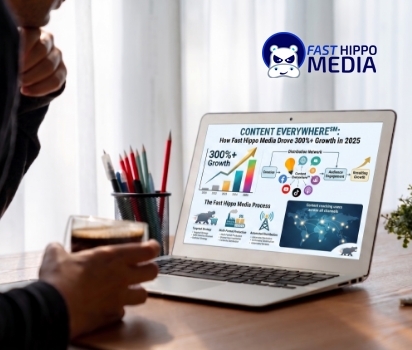
Fast Hippo Media publicly reported more than 300% year-over-year revenue growth in 2025 following the internal launch of Content Everywhere℠ , our proprietary omnichannel content operating system. This piece breaks down what Content Everywhere℠ actually is, the six channels it orchestrates, the production rhythm it runs, and the framework Frisco businesses can use to replicate the model.
In late 2024, Fast Hippo Media made a strategic bet that ended up reshaping the agency. We had been growing steadily, with solid SEO and paid-media work, a competent client list, and a Dallas office that had served the north Texas market for years. But the growth rate was linear, and the underlying mechanics were becoming saturated. Generic SEO services were commoditizing. Paid-media management fees were under pressure. Our differentiation against the dozens of competing agencies in North Texas was thinning.
The bet: stop trying to win by doing more of the same disciplines better, and instead build the operating system for an entirely new discipline, coordinated omnichannel content distribution at a scale and rhythm that no single-channel competitor could match. We called the system Content Everywhere℠ and launched it as our internal growth engine in early 2025. By year-end, the agency had reported more than 300% year-over-year growth and opened a third office in Frisco at 7700 Preston Rd, Ste. 401, in 75034 specifically to serve the four-neighborhood Frisco market (Frisco Square, The Star District at the Dallas Cowboys campus, Stonebriar including HALL Park, and Starwood across west Frisco) with the same platform.
This piece is the inside story and the framework Frisco businesses can use to replicate the model.
The 2024 problem that forced Content Everywhere℠
The strategic problem we faced in 2024 was structural, not tactical. Three things were happening simultaneously that traditional agency disciplines were not solving:
First, AI search adoption was accelerating beyond what single-channel SEO programs could address. Clients with strong Google rankings were starting to ask why they were not appearing in Google AI Overview, ChatGPT, or Claude. The answer required content and entity work across multiple surfaces, not just on-page optimization.
Second, buyer attention was fragmenting across more channels. Sophisticated B2B and luxury B2C buyers were researching across Google, LinkedIn, YouTube, Instagram, podcasts, AI engines, and press simultaneously. A business present in one or two channels was missing most of the journey.
Third, the production economics of running each channel as a separate operation were not working. Six vendors meant six contracts, six measurement frameworks, six creative briefs per quarter, and zero coherent strategy. Clients were paying for fragmentation.
The Content Everywhere℠ thesis was that an integrated production model running all six channels as one operating system would produce materially better outcomes than the fragmented vendor approach and would be the foundational platform for the next decade of agency work.
What “omnichannel” actually means in practice
“Omnichannel” is one of the most overused and least precisely defined words in marketing. For Content Everywhere℠ specifically, omnichannel means:
A single editorial strategy. One voice, one positioning, one content pillar set defined once and applied across every channel.
Coordinated production rhythm. One cornerstone content piece produced per week, with derivative formats shipped across all six channels within the same week. Not “post the same thing six places,” actual format-native adaptation (long-form article, short-form social, vertical video, podcast pitch angle, email newsletter inclusion, press talking point).
Shared measurement. One dashboard tracking impressions, engagements, conversions, and citation density across all six channels with attribution wired through to closed revenue where possible.
A single accountable team. No vendor handoffs, no “the social team did not coordinate with the SEO team” excuses. One production unit runs the whole motion.
The model is harder to operationalize than it sounds. Most agencies pretend to deliver it; few actually do. The internal investment required to build the workflows, hire the talent, and maintain the production cadence is significant. The payoff, when it works, is a structural advantage.
The six channels Content Everywhere℠ orchestrates
Channel 1 Search and AI. SEO, AEO, Map Pack, AI Overview, voice. The base layer. Without it, the other five channels generate traffic that does not convert.
Channel 2 Social and visual. Instagram, TikTok, Facebook, LinkedIn, and X each run in its native format and are matched to the category audience.
Channel 3 Video. YouTube long-form for evergreen authority. Shorts, Reels, TikTok for top-of-funnel. Every transcript is indexed for search and AEO.
Channel 4 Audio. Podcast guest placements that put your subject-matter expert in front of audiences search alone cannot reach. Hosted podcasting where the category and resourcing support it.
Channel 5 Earned media. Real PR work in trade publications, regional outlets (D Magazine, Frisco Style, Dallas Business Journal, Community Impact), and niche category publications. AI engines treat these as authoritative citation sources.
Channel 6 Owned. Website, blog, email, gated downloads, CRM nurture. The conversion engine that the other five channels point at. 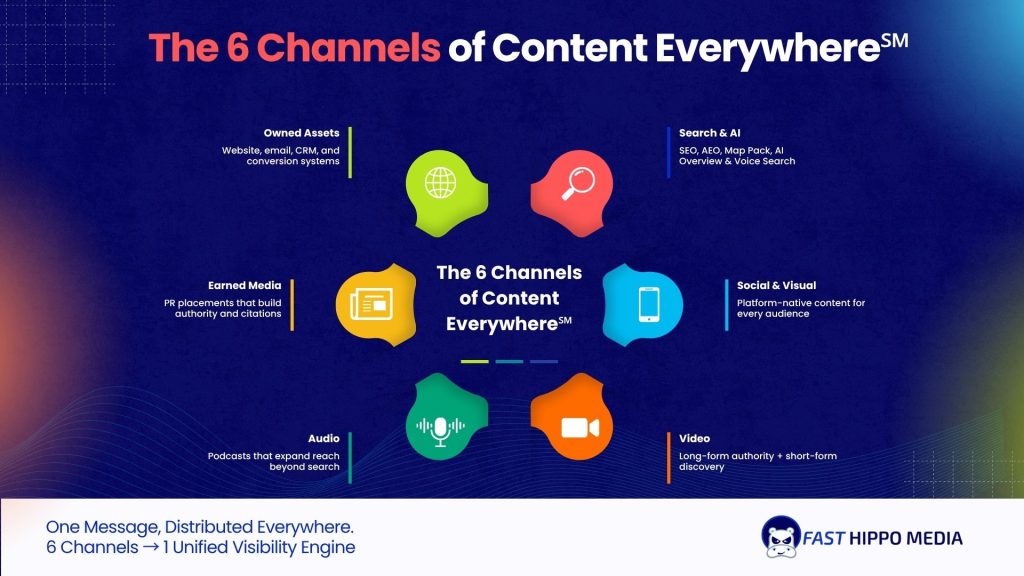
The production rhythm that makes it sustainable
The single thing that breaks most omnichannel ambitions is sustainability. The first 90 days look great; by month nine, content production has slowed, social cadence has lapsed, and the platform has reverted to “primarily SEO with some social on the side.”
Content Everywhere℠ solves this through a documented production cadence:
One cornerstone content piece per week, long-form article, video, or podcast produced by the subject-matter expert plus the production team. This is the anchor.
Six derivative formats per cornerstone piece, shipped within the same week: short-form social posts, video clips, podcast pitch angles, email newsletter inclusion, press talking points, and FAQ schema entries. Each format is produced for native consumption on its channel.
Quarterly editorial reset where the team reviews what is converting, what is not, and adjusts the content pillar mix accordingly.
Annual brand and positioning audit to keep the voice and strategic emphasis fresh.
The rhythm is real work. It is also what makes the platform compound rather than burn out.
How AI engines reward Content Everywhere℠ specifically
The Content Everywhere℠ model maps cleanly onto how AI engines build citation confidence. AI engines prefer entities with consistent identity across multiple authoritative sources, with deep topical content across multiple formats, with structured data confirming the content structure, and with recency signals showing the business is active and current.
A single-channel content operation produces signal density on one surface. A six-channel Content Everywhere℠ operation produces signal density on all six, and the cross-channel entity reinforcement compounds AI engine confidence faster than any single channel could.
In our own measurement, the AI engine citation curve for Content Everywhere℠–run accounts is materially steeper than for clients on traditional single-channel SEO programs. Initial citations appear faster, citation density builds faster, and the moat is wider. The mechanics are observable; the outcomes are repeatable.
The framework for replicating the model in your business
Five steps to replicate the model:
Step 1: Define a single editorial strategy. One voice, one positioning, one set of three to five content pillars that everything you publish ties back to. If you cannot articulate this on a single page, you do not have a strategy yet.
Step 2: Identify the subject-matter expert(s). Every cornerstone piece needs a human expert behind it. For most businesses, this is the founder or a senior practitioner. Their time is the constraint, and the production model has to respect that.
Step 3: Build the production unit. Either internally or with an agency partner, you need the production capability for long-form content, video, podcast pitching, PR outreach, social adaptation, and email. Half-measures do not produce the omnichannel outcome.
Step 4: Set the cadence and protect it. Weekly cornerstone, weekly derivatives, quarterly resets, annual audits. Calendar it. The cadence is what creates compounding.
Step 5: Measure across all six channels with one dashboard. Fragmented measurement produces fragmented outcomes. The integrated dashboard is what enables the strategic adjustments that keep the platform sharp.
For most businesses, building this in-house is a 9–18 month investment in talent, workflow, and tooling. For most Frisco service businesses with $1M+ annual revenue and growth ambition, hiring an agency partner running the platform at scale is the materially more cost-effective path.
Want this work done for your Frisco business?
Frequently Asked Questions
Yes. Fast Hippo Media publicly reported the year-over-year growth figure via press release in January 2026. The full release is available on our newsroom page and via standard PR distribution archives.
For businesses with $1M+ annual revenue and the strategic patience to compound over 12–24 months, yes though typically with an agency partner running the platform at scale rather than building all the production capability in-house. Below that revenue range, focused SEO + AEO produces better early ROI.
Content marketing typically means producing content. Content Everywhere℠ means producing content and orchestrating its distribution across six interconnected channels with shared measurement and a coordinated production rhythm. The operational difference shows up in outcomes measured in months 6, 12, and 24.
Yes. All client content is fully owned by the client. The platform is the operating system; the content is yours.
Most engagements are 12–24 months minimum because the compounding curve does not become fully visible until month 12+. Many clients renew indefinitely; the platform’s value compounds as long as it is running.