(214) 272-7034
  info@fasthippomedia.com


Frisco is changing faster than any other local search market in Texas, not because the city is growing fastest (it is, but that is not the reason), but because of the combination of five structural factors that compress search-behavior shifts into shorter timeframes. This guide breaks down those five factors and what they mean for businesses that want to lead rather than lag the curve.
Texas has fast-changing local search markets: Austin tech, Houston energy, San Antonio hospitality, and Plano corporate. Each one has distinct characteristics that shape buyer search behavior in measurable ways. But Frisco is changing faster than any of them.
The reason is not population growth (Frisco is, in fact, the fastest-growing large city in the United States, but growth alone does not change search dynamics). The reason is a combination of five structural factors that compress search-behavior shifts into shorter timeframes. Understanding those factors is how a Frisco business operator anticipates the next 24 months instead of chasing them.
What “fastest-changing” actually means for a local search market
“Fastest-changing” is not the same as “biggest.” A market changes fast when the rate of structural shift in buyer behavior outpaces the rate at which incumbent businesses adapt. The gap between buyer expectation and incumbent execution is the opportunity window.
In Frisco, that gap is currently wider than in any other Texas market we operate in. Buyers are adopting AI search, demanding hyperlocal relevance, expecting credibility-first conversion experiences, and rewarding businesses present across multiple discovery channels, but most incumbent Frisco businesses are still running 2020-era marketing playbooks. The mismatch creates a window for businesses willing to lead the shift.
Factor 1: demographic AI-adoption velocity
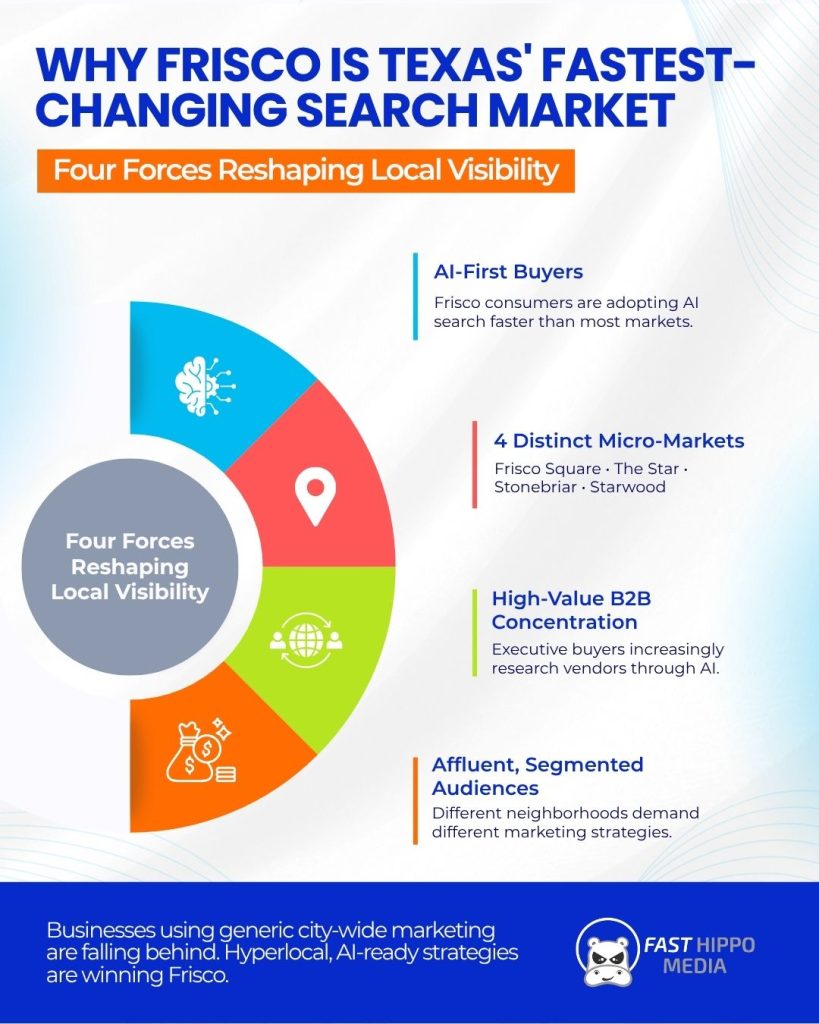
Frisco’s population skews professional, affluent, and Apple-device-dominant, three demographic factors that correlate strongly with early AI-search adoption.
Median household income in 75034 runs above $111,000 (and approaches $160,000 in the gated west-side communities like Starwood). The professional/managerial workforce concentration includes McAfee, Comerica, the Cowboys org and its tenant ecosystem, multiple Fortune 500 satellite offices, and the surrounding ring of high-revenue medical, legal, financial, and home-services businesses serving that workforce.
Across that demographic profile, AI search adoption (ChatGPT, Claude, Perplexity, Gemini, Google AI Overview) has accelerated 12–24 months ahead of national averages. Frisco buyers ask AI before they Google. That single behavioral shift, scaled across the city, fundamentally changes which businesses get shortlisted for high-value purchases.
Factor 2: hyperlocal fragmentation across four neighborhoods
Most Texas cities are functionally one market for local search purposes. Frisco is at least four: Frisco Square (civic core), The Star District (Cowboys campus B2B and luxury B2C), Stonebriar (established commercial, mall, country club, HALL Park), and Starwood (gated west-side affluence). Each operates as its own micro-market with distinct buyer behavior, competitive set, and search pattern.
The fragmentation means generic “Frisco SEO” captures a fraction of the available demand. The businesses winning Frisco in 2026 are the ones running neighborhood-specific architectures, and the businesses competing on a single “Frisco” page are leaving 60–80% of long-tail intent uncaptured.
That fragmentation pressure also accelerates change: the agencies and businesses that recognize the architecture shift early outpace those that do not. The competitive gap compounds quarterly.
Factor 3: B2B concentration around the Cowboys campus
The Star District concentrates B2B search demand in a way no other Texas neighborhood does. The Cowboys org and the Fortune 500 corporate offices on or near Cowboys Way (McAfee, Comerica, multiple regional headquarters) generate executive-level B2B research volume that exceeds what most Texas cities’ entire downtowns produce.
B2B search behavior is also among the most AI-driven. Corporate buyers researching agencies, vendors, professional services, and IT solutions increasingly start in LLMs (Claude and ChatGPT, especially) and only validate with Google. The Frisco B2B audience is the most AI-mature segment we monitor in Texas.
For B2B businesses targeting Cowboys-campus-adjacent buyers, AEO is no longer optional; it is the primary battleground for shortlist consideration.
Factor 4: the wealth gradient from Frisco Square to Starwood
Frisco’s income gradient from the $111K household median in the civic core to the $159K household average in gated Starwood, with corresponding shifts in buying behavior, brand sensitivity, and AI adoption, creates a marketing environment unlike any other Texas city of similar size.
The implication: businesses serving Frisco need to think about audience segmentation at a level of granularity that simply does not apply in most Texas markets. The marketing program that works for a Frisco Square restaurant does not work for a Starwood targeting custom builders, even though both are “Frisco businesses.”
That granularity demand accelerates strategic shifts. Businesses that can think hyperlocally win disproportionately; businesses that cannot lose share at compounding rates.
What this means for businesses that want to lead the curve
Three concrete moves:
First, treat AEO as core, not as a bolt-on. The AI-search adoption curve in Frisco is steeper than in any other Texas market. Investing in AEO in 2026 is the equivalent of investing in organic SEO in 2010, early and compounding.
Second, deploy hyperlocal architecture before competitors do. Most Frisco businesses still operate on a single-page “Frisco” content footprint. Building dedicated pages for Frisco Square, The Star District, Stonebriar, and Starwood (and the surrounding micro-markets where you do business) is a 9–18 month moat.
Third, build omnichannel content distribution. Frisco buyers research across more channels than buyers in most Texas markets. A single-channel content strategy underdelivers; an integrated content program across search, social, video, audio, earned media, and AI engines compounds.
The Frisco businesses that win the next 24 months are the ones moving on all three of these now. The ones that wait until 2027 will be displacing incumbents who got there first at materially higher cost.
Want this work done for your Frisco business?
Frequently asked questions
Different metrics. Austin is changing fastest in tech-specific verticals (SaaS, B2B software, startup-adjacent services). Dallas is changing fastest in scale (sheer search volume across diverse categories). Frisco is changing fastest in the rate at which buyer behavior shifts ahead of incumbent business adaptation. The strategic gap is wider in Frisco than in either Austin or Dallas.
For most professional-services categories, the AEO citation gap closes meaningfully by mid-to-late 2027 as national agencies deploy AEO programs at scale. Hyperlocal architecture advantage compounds longer — businesses that build neighborhood-page footprints in 2026 will defend that position through 2028+. The window is currently open and progressively closing.
They are the highest-density micro-markets for most categories in 2026. Phase 2 expansion neighborhoods (Phillips Creek Ranch, Newman Village, Hollyhock, downtown Frisco, the Lebanon Road corridor) are on most hyperlocal roadmaps for 2027.
Yes. Geographic proximity is one ranking signal among many; entity signaling, schema deployment, content depth, and citation density all work for businesses headquartered outside Frisco that explicitly target Frisco micro-markets.
Waiting. The structural shifts described above are not slowing down. Businesses that wait for the “right time” to invest in AEO, hyperlocal architecture, or omnichannel content distribution are letting competitors claim positions that will be materially more expensive to displace later.