(214) 272-7034
  info@fasthippomedia.com


Most Frisco businesses see initial Map Pack movement in 60–90 days, top-three positions for primary categories in 90–180 days, and stable defensive positions in 6–12 months. Highly competitive Frisco verticals (legal, medical specialty, cosmetic surgery) take 9–18 months. The variables that move the timeline are real: category competitiveness, starting position, retainer size, and review velocity. This is what each month actually looks like.
The single most common question we hear from Frisco business owners is also one of the hardest to answer cleanly: how long until we rank in the Map Pack? Honest answers come with variables. Dishonest answers come with promises.
The real timeline depends on four factors — your category’s competitive density, the state of your Google Business Profile and on-page foundation when work starts, your retainer size and the speed at which work can ship, and your ongoing review velocity. The same category, the same agency, and the same retainer can produce a 60-day Map Pack lift in Frisco Square (where civic-adjacent professional services have less mature competition) and a 9-month timeline in Stonebriar (where the HALL Park and Stonebriar Centre competitive set has been investing in SEO since 2018). A cosmetic surgeon targeting Starwood and Phillips Creek Ranch households will see different ranking velocity than a B2B vendor selling into the McAfee and Comerica offices at The Star District. Below is what each phase actually looks like, drawn from real Frisco engagements across all four neighborhoods.
Why the Frisco Map Pack timeline question is harder than it looks
The Map Pack is a three-slot block. Google evaluates dozens of signals to assign those three slots: GBP completeness, primary category accuracy, secondary category coverage, attribute completeness, review velocity and recency, review keyword content, citation consistency across the open web, on-page entity signals, proximity to the searcher, and an entity authority signal that compounds over time.
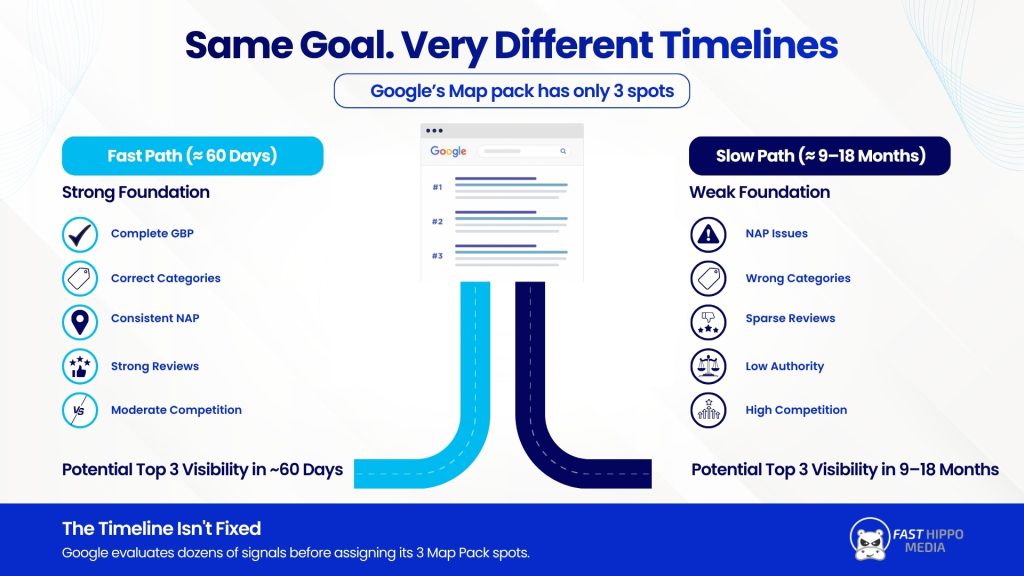
For a Frisco business starting with a clean foundation in a moderately competitive vertical, those signals can move into top-three position quickly — sometimes inside 60 days. For a business starting with NAP inconsistencies, a mis-categorized GBP, sparse reviews, and a hyper-competitive vertical (cosmetic surgery, family law, personal injury), the same outcome can take 9–18 months.
Ignore agencies that promise specific Map Pack rankings within specific timeframes. The honest answer is always conditional.
Month 1: foundation (no ranking movement yet)
The first month of a Frisco Map Pack engagement is foundation work. Expect no ranking movement, because the signals that drive movement have not been built yet.
What ships in month 1: NAP cleanup across 60+ aggregators (Google, Bing, Apple Maps, Yelp, Foursquare, the data aggregators that feed voice assistants), GBP rebuild (primary category audit, secondary category expansion, attribute completion, services and products list, photo refresh, posts schedule), schema deployment (LocalBusiness, Service, Place, FAQPage, BreadcrumbList), technical SEO fixes (Core Web Vitals, mobile usability, indexability), and on-page rewrites of the top 5–10 revenue pages with hyperlocal language and entity reinforcement.
You should see a written punch list from the agency by day 14, with deliverables you can verify. If you cannot verify what shipped, you cannot trust what comes next.
Months 2–3: initial Map Pack lift
Months 2 and 3 are where initial Map Pack movement becomes visible. The exact magnitude depends on category competition and starting position.
For a Frisco business in a moderately competitive vertical (boutique medical, professional services, home services, niche B2B) with a clean foundation, expect to see top-five Map Pack positions for primary categories by the end of month 3. Top-three positions are achievable in this window if competitor GBPs are weak.
For highly competitive verticals (cosmetic surgery, family law, personal injury, financial planning) with strong incumbents, expect to be moving from position 10–15 into position 6–8 by the end of month 3. Top three in these categories typically takes longer.
Initial AI Overview citations also appear in this window for businesses where the AEO foundation has been deployed correctly. AI Overview adoption tends to lead Map Pack movement by 2–4 weeks because AI engine evaluation cycles are faster than Map Pack re-ranking cycles.
Months 4–6: compounding authority
Months 4 through 6 are when authority compounds. Content production hits stride, review velocity matures, citation density builds, and AEO citations stabilize.
For moderately competitive Frisco verticals, this is the window where most businesses reach stable top-three Map Pack positions for primary categories and see meaningful AI Overview presence for the top question queries. Qualified lead volume from organic and Map Pack traffic typically lifts 40–80% above baseline by the end of month 6.
For competitive Frisco verticals, this is the window where top-three Map Pack positions become realistic for primary categories. Incumbent dominance starts to crack as your authority signals catch up.
Cost per qualified lead also typically begins dropping in this window because organic and AEO-driven lead volume increases without proportional spend increase, lowering the blended customer acquisition cost.
Months 7–12: defensive position
Months 7 through 12 are the defensive phase. By this point, the engagement has built a moat that competitors find difficult to displace.
For most Frisco categories, by month 12 the engagement should be producing stable top-three Map Pack positions for primary categories, consistent AI Overview citations for question queries, and a compounding lead-volume curve that increasingly outpaces marginal retainer investment.
This is when the engagement starts producing 3–10x ROI on retainer, depending on category economics. It is also when most clients renew for year two — not because they are obligated, but because the work is producing returns that compound month over month.
For highly competitive verticals, months 7–12 are when top-three Map Pack positions become stable and the next layer of competitive ambition (national category visibility, branded search dominance, executive thought leadership) opens up as a strategic option.
What can speed up the timeline (and what cannot)
Three levers actually accelerate Map Pack timelines:
Larger retainer. More work ships faster — content production at higher volume, more aggressive PR and citation building, faster review velocity programs. A $10,000/month engagement moves materially faster than a $5,000/month engagement in the same category.
Existing brand authority. A Frisco business with strong organic presence, recognized brand, or established offline reputation (in-bound press coverage, industry recognition, professional credentials) typically reaches top-three Map Pack faster because the entity signals are already partially built.
Aggressively paid amplification. Running Google Ads and Local Service Ads alongside the organic program produces dual benefit — immediate qualified lead volume, and signal reinforcement to Google’s algorithm that you are an active, in-demand business in the category.
What does not accelerate the timeline: link-buying schemes, “guaranteed” review acquisition programs (Google bans the obvious ones), or pressuring the agency to “do more this month.” Map Pack ranking is determined by signal accumulation. Signals accumulate at the pace of trustworthy work. Anything that pretends to shortcut that creates risk without acceleration.
Want this work done for your Frisco business?
Frequently Asked Questions
Stonebriar’s competitive set has 5–10 more years of accumulated GBP and review density than most Frisco Square competitors. The entity authority signals that drive Map Pack ranking compound over time, and incumbents with a decade of accumulated signal are harder to displace. The work is the same; the timeline is longer.
Significantly. Google weights recent reviews more heavily than older reviews, and weights review keyword content for relevance to the search query. A Frisco business adding 8–12 high-quality reviews per month with relevant keywords outperforms a business with 800 stale reviews. Building review velocity is one of the highest-leverage levers for accelerating Map Pack timelines.
Yes, but the timeline is longer. New entrants typically need 9–12 months of disciplined GBP optimization, review velocity, citation building, and on-page entity work before they consistently rank top three for primary categories against established incumbents. The playbook works; the runway is real.
Diagnostic conversation needed. Ask for specific evidence of what foundational work has shipped — NAP cleanup, GBP optimization, schema deployment, on-page rewrites, content production, review velocity. If foundational work has shipped and there is no Map Pack movement by month 3, either the work is wrong, the category is more competitive than initially assessed, or the agency is reporting on wrong metrics. Honest agencies will diagnose openly.
Partially and temporarily. Map Pack positions decay slowly as competitors continue investing while you stop. Most businesses that stop a Frisco engagement see meaningful ranking erosion within 6–12 months. The compound advantage of ongoing work is real; the depreciation curve of stopped work is also real.