(214) 272-7034
  info@fasthippomedia.com


SEO ranks your website in Google’s blue links. AEO gets your business cited as the answer in Google AI Overview, ChatGPT, Claude, Perplexity, Gemini, and voice assistants. They share foundations (entity clarity, schema, content structure) but their optimization targets and measurement frameworks are different. For a Frisco business in 2026, the question is no longer “which one.” It is “how do we deploy both.”
The acronyms look interchangeable. They are not. Search Engine Optimization (SEO) and Answer Engine Optimization (AEO) target different surfaces, work through different mechanics, and require different measurement frameworks. They share infrastructure — entity graphs, schema markup, on-page content structure — but the strategic decisions they require are distinct.
For most of the last decade, “SEO” sufficed because Google’s ten-blue-link experience was the dominant discovery surface. That world is over. By mid-2026, the average high-intent local search session in Frisco touches multiple AI-driven surfaces (Google AI Overview, ChatGPT, Claude, Perplexity, Gemini, Apple Maps with Siri AI integration) before the buyer even reaches a traditional organic result. The Frisco business that has not added AEO to its program is leaving market share on the table — quietly and continuously.
Definitions: what each discipline actually does
SEO — Search Engine Optimization. The discipline of ranking your website higher in traditional search-engine results. Inputs: keyword research, on-page optimization, technical SEO (Core Web Vitals, indexability, schema), internal linking, content production, backlink earning, and Google Business Profile optimization. Output: blue-link position, Map Pack position, and (until recently) featured snippet capture.
AEO — Answer Engine Optimization. The discipline of being cited as the answer in AI-driven search surfaces. Inputs: question-form content with direct sub-60-word answers, FAQPage schema, entity reinforcement across authoritative sources, topical depth, structured data, and citation density in publications the AI engines treat as trustworthy. Output: citation in Google AI Overview, named recommendation in ChatGPT/Claude/Perplexity/Gemini, and surfacing in voice-assistant responses.
The two disciplines overlap meaningfully — entity clarity, schema, and on-page content quality are inputs to both. But the optimization targets are different, the measurement is different, and the strategic emphasis is different.
How the algorithms differ in 2026
Google’s organic algorithm scores pages on a mix of relevance, authority (backlinks, brand mentions), user experience signals (Core Web Vitals, dwell time), and content quality. The unit of ranking is a URL.
Google’s Map Pack scores businesses on proximity, prominence (review velocity, citation density), and relevance. The unit of ranking is a Google Business Profile.
AI Overview and LLM answer engines score differently. They are looking for entities that the model is confident are the authoritative answer to the question being asked. The inputs are different: question-format content, structured data, citation density across multiple high-trust sources, topical depth, and recency. The unit of ranking is not a URL or a GBP — it is the entity itself (a business, a person, a brand) and the citation graph that supports it.
This is the structural shift that makes AEO a separate discipline. A site that ranks well in Google organic may still be invisible in AI Overview if the entity signals are not built. Conversely, a site that has been engineered for AEO from the ground up will often surface in AI engines before its organic rankings catch up — because the AI engine evaluation criteria are different from organic ranking criteria.
Why Frisco specifically needs both right now
Frisco’s audience composition makes the AEO opportunity unusually acute. Three demographic factors converge:
First, Frisco residents over-index on AI-search adoption. Median household income in 75034 runs above $111,000, with concentrations of professional and managerial workers, sophisticated B2B buyers at corporate campuses like McAfee and Comerica on Cowboys Way, and the gated affluent west-side communities. Every one of those demographic segments is among the heaviest early adopters of AI search nationally.
Second, the city is geographically fragmented. Frisco Square, The Star District, Stonebriar, and Starwood each have distinct buyer behaviors and search patterns. Hyperlocal AEO content tuned to each neighborhood compounds advantage in ways generic Frisco SEO cannot.
Third, the competitive set is partially asleep. The established Frisco competitors — long-tenured law firms, medical practices, financial advisors — have built strong traditional SEO over the past decade but have not yet retooled for AEO. That gap is a once-per-decade competitive window that will close as incumbents catch up. Businesses investing in AEO now are claiming a structural moat that incumbents will struggle to close once the market matures.
How the disciplines reinforce each other
SEO and AEO are not zero-sum. They share infrastructure and reinforce each other operationally.
Strong technical SEO (clean schema, fast load, indexable structure) makes AEO faster to deploy because the foundational entity work is already done. Strong organic content with question-form H2s and direct answers (typical of well-written modern SEO content) is already half-optimized for AEO. Modern schema deployment serves both disciplines simultaneously.
Conversely, AEO work pulls SEO performance up. Question-form content earns featured snippets. FAQPage schema supports rich results. Authority citations earned for AEO citation purposes also serve as organic ranking signals. The disciplines compound when delivered together.
The mistake we routinely audit is businesses that hired one agency for “SEO” and a different vendor for “AI content” — and the two programs never integrated. The schema is inconsistent, the entity signals are fragmented, and the measurement is incoherent. Run both disciplines as one integrated program with a single point of accountability, or run neither well.
How to know if your agency is delivering AEO or just rebranded SEO
AEO is the new buzzword, which means most SEO agencies are now claiming to deliver it. Few actually do. Two diagnostic questions cut through the marketing:
“Show me your AEO measurement methodology.” A real answer is documented, replicable, and weekly — tracking AI Overview citations, LLM mentions across ChatGPT/Claude/Perplexity/Gemini, branded search volume growth, and question-query conversion attribution. A fake answer is a single chart of “AI visibility” from a third-party tool nobody else uses.
“Show me an example of question-form content you have published for a client, the FAQPage schema deployed with it, and the AI Overview citation it earned.” Real agencies have receipts. Fake agencies have decks.
A 90-day combined SEO + AEO rollout plan
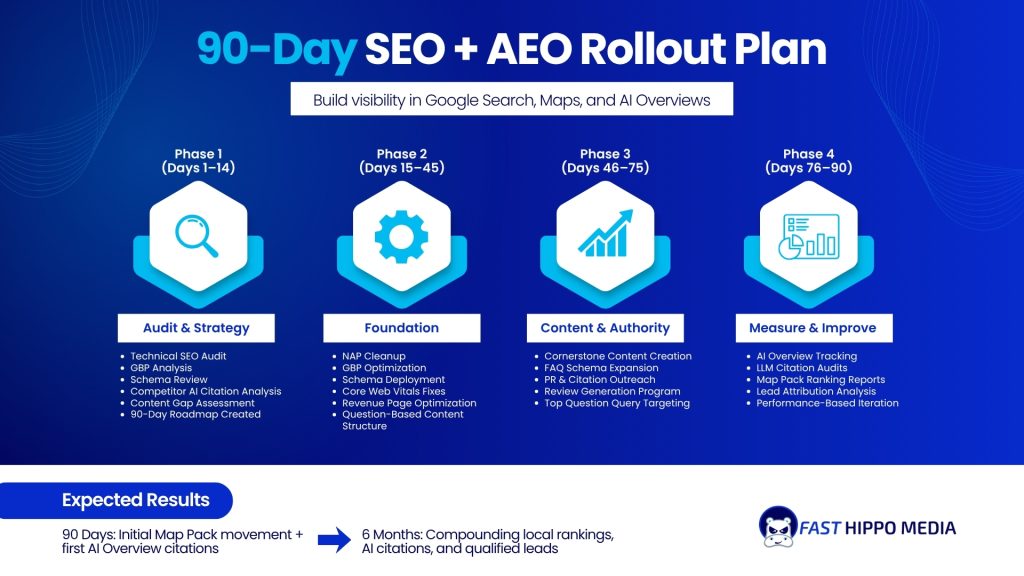
Days 1–14: Audit. Technical SEO baseline, GBP analysis, schema audit, competitor AI Overview citation analysis, content gap assessment. You should have a written 90-day roadmap with measurable milestones by day 14.
Days 15–45: Foundation. NAP cleanup, GBP rebuild, schema deployment (LocalBusiness, Service, Place, FAQPage, BreadcrumbList, all connected via @id), Core Web Vitals fixes, on-page rewrites of your top revenue pages with question-form H2s and direct answers.
Days 46–75: Content and authority. Cornerstone content production targeting your top 25 question queries, FAQ schema on every important page, initial PR/citation outreach to publications AI engines treat as authoritative, and review velocity program launch.
Days 76–90: Measurement and iteration. Weekly AI Overview tracking, monthly LLM citation audits, Map Pack ranking reports, qualified lead attribution. Iteration on what is moving and what is not.
By the end of 90 days, you should be seeing initial Map Pack movement and the earliest AI Overview citations. By the end of 6 months, both should be compounding visibly.
Want this work done for your Frisco business?
Frequently Asked Questions
No. AEO is built on top of strong SEO foundations. A site with broken schema, slow Core Web Vitals, or no on-page entity signals will not earn AEO citations no matter how much question-form content gets added. The two disciplines coexist; AEO extends rather than replaces SEO.
Some can; most cannot. The diagnostic is methodology, not vocabulary. If your current agency can show you a documented AEO methodology with replicable measurement and real citation examples, they can probably extend. If they cannot, hiring a separate AEO specialist is likely cleaner than waiting for them to learn it.
Two operational changes. First, every important page gets restructured around question-form H2s with direct sub-60-word answer paragraphs. Second, every page gets FAQPage schema for FAQs that are actually on the page. Content production volume does not necessarily increase; content structure changes.
Categories where buyers do not research before purchasing (commodity B2C purchases, impulse F&B) see lower AEO impact. Categories where buyers research carefully before purchasing (professional services, healthcare, B2B, home services, luxury services, education) see disproportionate AEO impact. Most Frisco service businesses fall in the second category.
Already has, for many query types. The strategic response is to be cited in AI Overview rather than to fight against it. Businesses cited above the organic results are not losing traffic; they are capturing it from a different surface. Businesses absent from AI Overview but ranking organic position one are losing share quietly.