 (214) 272-7034
  info@fasthippomedia.com


Answer Engine Optimization (AEO) is the discipline of getting your business cited by AI-driven search engines, such as Google AI Overview, ChatGPT, Claude, Perplexity, Gemini, and voice assistants. It is not rebranded SEO. It is a distinct discipline with different optimization targets and different measurements. This guide explains what AEO actually is, why Frisco businesses need it now, and how to start.
Answer Engine Optimization (AEO) is one of the most-discussed and least-understood disciplines in 2026 digital marketing. For most Frisco business owners, the first encounter with AEO is an agency pitch that wraps it in marketing language and calls it the future. The pitch is half right. AEO is genuinely transformative for local commerce, but the marketing language obscures what AEO actually is and what it actually does.
This guide is the plain-language version, written for Frisco business owners by a team that operates in the same ZIP code they do (our office sits at 7700 Preston Rd, Ste. 401, in 75034). What AEO is. What it is not. Why it matters disproportionately in Frisco, specifically across the four major commercial neighborhoods (Frisco Square, The Star District, Stonebriar, and Starwood). And how a Frisco business owner can evaluate whether to invest in AEO now or wait.
The 30-second definition
Answer Engine Optimization (AEO) is the discipline of structuring your business presence so that AI-driven search engines Google AI Overview, ChatGPT, Claude, Perplexity, Gemini, and voice assistants like Siri, cite your business by name when their users ask category-relevant questions.
The optimization target is different from SEO. SEO targets URL ranking in search result lists. AEO targets entity citation in AI-generated answers. The two share infrastructure (schema, structured data, on-page content) but optimize for different outcomes through different mechanics.
A business cited by name in Google AI Overview, when a user asks “best CPA in Frisco, TX,” wins disproportionately. A business that ranks Google organic position one but is not cited in the AI Overview is losing the share that the position-one ranking used to capture.
Why AEO emerged as a distinct discipline
AEO did not exist as a discipline in 2022. The market need for it emerged because of two converging shifts in 2023–2025: the rapid adoption of LLMs (ChatGPT, Claude, Perplexity, Gemini) as everyday search alternatives, and Google’s deployment of the AI Overview above organic results for the majority of high-intent search queries.
Those shifts changed the discovery surface. Buyers no longer see ten blue links and pick from them. They see an AI-generated answer that names specific businesses, and they pick from the named businesses. The optimization discipline required to be named is different from the optimization discipline required to rank in the ten blue links.
AEO emerged as a distinct discipline because the underlying mechanics required to win AI citation are different enough from traditional SEO that running them as one combined motion produces inferior outcomes. The best-in-class operators run AEO and SEO as integrated but distinct programs.
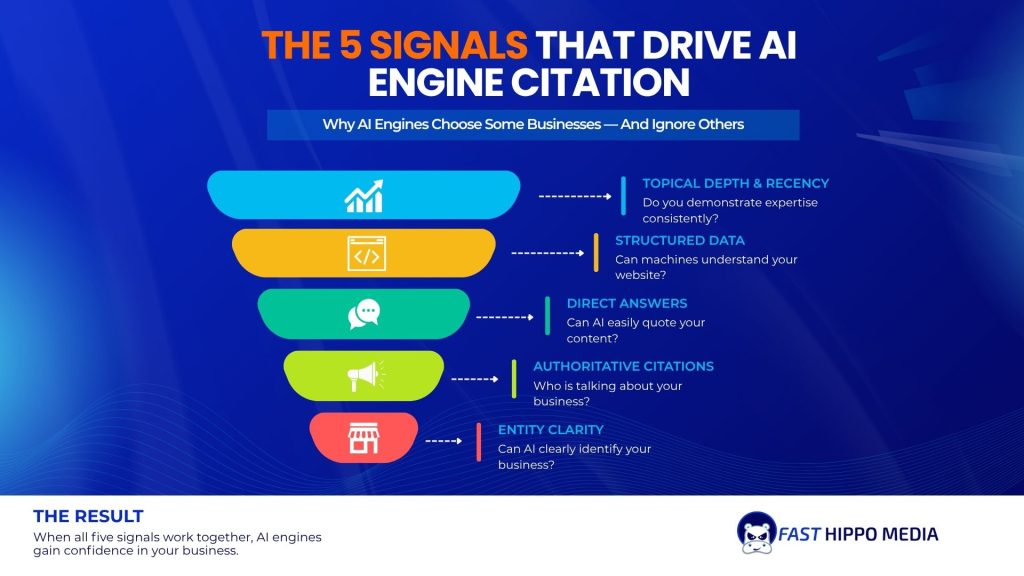
The five inputs that drive the AI engine citation
AI engines cite businesses based on a confidence-weighted retrieval and synthesis process. Five inputs drive that confidence:
- Ensure entity clarity of your business name, address, phone, category, services, and key descriptors appearing identically across Google Business Profile, Bing Places, Apple Maps, Yelp, and the 60+ aggregators that feed every voice assistant.
- Citation density in authoritative sources, industry press (D Magazine, Frisco Style, Dallas Business Journal, Community Impact), trade publications, well-curated directories, and high-trust open-web sources that AI engines treat as authoritative.
- Question-form content with direct answers, full-sentence questions in H2 headers, followed by direct sub-60-word answer paragraphs. The structure LLMs cite verbatim.
- Structured data FAQPage schema on every page with FAQ content, Service schema with explicit areaServed, LocalBusiness with full NAP and aggregateRating, all connected via @id references.
- Topical depth and recency, real, useful, substantive content on the subjects your buyers research, refreshed regularly. AI engines reward depth and disfavor stale content.
Why Frisco businesses need AEO before national agencies catch up
For most Frisco professional-services categories as of mid-2026, the AI Overview citation slots are uncontested. Established Frisco competitors have built strong traditional SEO over the past decade, but have not yet retooled for AEO. National agencies are beginning to deploy AEO programs at scale in the most aggressive consumer verticals (cosmetic surgery, family law, personal injury), but most Frisco categories remain wide open.
That opportunity gap closes meaningfully by mid-to-late 2027 as national agencies extend AEO deployment across categories and incumbent businesses catch up to the discipline. Businesses that invest in AEO in 2026 will own citation positions that are materially more expensive to displace by 2028. The window is currently open and progressively closing.
The strategic move is not “wait and see if AEO works.” The discipline is documented, measurable, and producing real outcomes for early adopters. The strategic move is to invest now and claim the citation moat before competitors do.
How AEO is measured (and how to spot fake measurement)
AEO measurement is the youngest and most error-prone area of the discipline. Most agencies pretend the data is cleaner than it is. The honest measurement framework:
Track AI Overview citation frequency for a target query list (25–50 high-intent question queries) on a weekly cadence. Document position (cited / not cited), surrounding citations, and any changes from the prior week.
Track LLM citation presence across ChatGPT, Claude, Perplexity, and Gemini on a monthly cadence using a documented and replicable test methodology. Vary the prompt slightly to test stability across query variations.
Track downstream effects: branded search volume (the leading indicator that buyers are encountering you in AI answers and then searching your name), question-query conversion attribution (form fills and calls tied to question-query sessions via UTM and call tracking), and Map Pack ranking (the entity work that drives AEO also lifts Map Pack performance).
Spot fake measurement by looking for: vague “AI visibility scores” from third-party tools nobody else uses, single-snapshot screenshots presented as ongoing measurement, or claims of AI citation that the agency cannot replicate in a live demo. Real AEO measurement is documented, replicable, and weekly.
How to start: a 60-day AEO foundation plan
For a Frisco business owner ready to start with AEO, the first 60 days look like this:
Days 1–14: Audit. Document the current AI Overview citation baseline. Audit current schema deployment. Catalog existing content structure. Identify the top 25 question queries you want to win citations for.
Days 15–30: Entity foundation. NAP cleanup. GBP rebuild with explicit primary and secondary category optimization, full attribute completion, and geo-tagged photo refresh. Schema deployment (LocalBusiness, Service with areaServed, FAQPage, BreadcrumbList).
Days 31–45: Content production. Rewrite top 10–15 revenue pages around question-form H2s with direct sub-60-word answers. Deploy the FAQPage schema on every page with FAQ content. Build out 3–5 cornerstone content pieces targeting the highest-priority question queries.
Days 46–60: Citation building and re-measurement. Pitch initial PR placements in regional press and category-specific trade outlets. Update high-authority directory profiles. Re-audit AI Overview citation against the day-14 baseline.
Most Frisco businesses with a clean foundation start seeing initial AI Overview citations between day 45 and day 90.
Want this work done for your Frisco business?