(214) 272-7034
  info@fasthippomedia.com


The category “Frisco SEO” is used to describe a coherent product. It does not anymore. Six interconnected disciplines (organic, Map Pack, AI Overview, LLM citation, Apple Maps/voice, social/visual search) now drive local commerce in Frisco. Agencies still selling “Frisco SEO” as a monolithic product are selling a fraction of what 2026 demands. This piece explains what replaced the old product and what to look for in a modern engagement.
For most of the past decade, “Frisco SEO” was a recognizable product. You hired an agency, they optimized your website, built backlinks, managed your Google Business Profile, ran some Google Ads, and reported on keyword rankings. The discipline was coherent because the underlying search experience was coherent: Google’s organic results dominated discovery, the Map Pack was a sidecar, and AI engines did not exist.
That world is gone. The Frisco businesses still buying “Frisco SEO” as a monolithic product are buying a 2020 deliverable against a 2026 algorithm. This piece explains what changed, why the old playbook underperforms, and the integrated discipline that has replaced it.
What “Frisco SEO” used to mean (and why it was enough until recently)
Through about 2022, “Frisco SEO” typically bundled: technical website optimization, on-page content for category keywords (“dentist Frisco TX,” “best lawyer Frisco”), backlink building, Google Business Profile setup and review management, and basic local-listing cleanup across major directories.
That bundle worked because the discovery surface was concentrated. Most local commerce searches happened on Google, most attention landed on the top three organic results plus the Map Pack, and the optimization disciplines required to win those positions were stable.
A competent agency running this playbook produced meaningful results for Frisco businesses through about 2022. The product was real, the price-to-outcome ratio was reasonable, and clients who invested in it consistently saw ranking and lead-volume lifts.
The four structural shifts that broke the old playbook
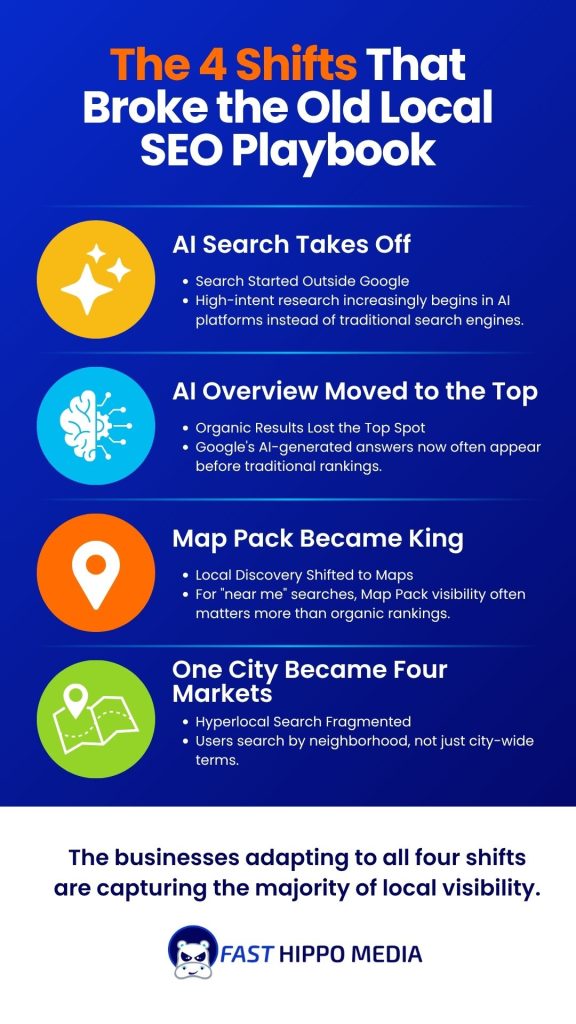
Four shifts converged between 2023 and 2026:
Shift 1: Generative AI changed how people search. ChatGPT launched late 2022; by mid-2024, it had hundreds of millions of users. Claude, Perplexity, and Gemini followed. By mid-2026, a meaningful share of high-intent purchase research in Frisco starts in an AI engine, not Google.
Shift 2: Google deployed AI Overview above organic. Starting in 2024 and expanding through 2025, Google’s AI-generated answer surface began appearing above the organic blue links for the majority of high-intent local queries. The “top of the page” is no longer the organic position one.
Shift 3: The Map Pack consolidated. As Google’s product evolved, the Map Pack moved from a sidecar surface to the dominant local-commerce discovery surface for “near me” intent. Map Pack ranking became more important than organic ranking for most local categories.
Shift 4: Hyperlocal demand is fragmented. Frisco’s four-neighborhood commercial structure (Frisco Square, The Star District, Stonebriar, Starwood) created search-behavior patterns that single-page “Frisco” content could not capture. The market structurally became four sub-markets without anyone announcing it.
The six surfaces that replaced single-channel “SEO”
Local commerce in Frisco in 2026 plays out across six interconnected surfaces:
- Google organic is still important, increasingly compressed.
- Google Map Pack the dominant local-commerce surface for “near me” intent.
- Google AI Overview: The AI-generated answer above is organic for most queries.
- LLM answer engines ChatGPT, Claude, Perplexity, and Gemini are increasingly the first stop for research-heavy purchases.
- Apple Maps and voice assistants are a distinct ecosystem with their own data sources and own optimization mechanics.
- Social and visual search TikTok, Instagram, Pinterest, and YouTube are functioning as discovery engines for visual categories and younger demographics.
- A Frisco business optimized for one of six surfaces captures a fraction of the available local discovery. The agencies that compete on all six produce materially better outcomes than the agencies that compete on one.
Why integrated programs outperform single-discipline ones
The temptation, when six surfaces compete for attention, is to hire six different specialists, one for SEO, one for AEO, one for social, one for video, one for paid, and one for content. The result is fragmentation: six vendors, inconsistent entity data, conflicting schema deployments, duplicate or contradictory content production, and no single accountability for results.
Integrated programs outperform because the underlying infrastructure compounds. The schema deployment that supports organic SEO also supports AEO. The content production that wins featured snippets also wins AI Overview citations. The PR work that builds backlinks also builds citation density. The GBP optimization that drives Map Pack ranking also feeds the AI engine entity confidence.
When one team owns all six disciplines, the work compounds. When six teams own one each, the work fragments. The cost difference is meaningful; the outcome difference is larger.
How to evaluate whether your current agency has retooled
Three diagnostic questions cut through the marketing language:
“Show me your AEO measurement methodology and a sample report.” Modern agencies have one documented, replicable, weekly. Agencies still selling 2020 SEO either do not have AEO measurement at all or wave their hands at “AI visibility scores” from third-party tools nobody else uses.
“Walk me through how you would optimize my business for the Map Pack, the AI Overview, ChatGPT/Claude/Perplexity, and Apple Maps simultaneously.” A modern agency has a coherent, integrated plan. A legacy agency pivots back to “we focus on Google rankings and let the rest follow.”
“What does your hyperlocal architecture look like for a Frisco client with multiple neighborhood-relevant audiences?” A modern agency builds dedicated landing pages per neighborhood with explicit Place schema and content. A legacy agency builds a single “Frisco” page and calls it done.
The 2026 standard for a Frisco marketing engagement
A competent Frisco engagement in 2026 includes:
- Hyperlocal content architecture with dedicated pages per relevant Frisco neighborhood.
- Schema deployment (LocalBusiness, Service, Place, FAQPage, BreadcrumbList) connected via @id references.
- Documented AEO methodology with weekly AI Overview tracking and monthly LLM citation audits.
- Active Google Business Profile management with weekly posts, monthly photo refresh, Q&A monitoring, and review velocity programs.
- Paid media (Google Ads, LSAs where applicable, Microsoft Ads, Meta, LinkedIn for B2B) wired to offline conversion uploads and CRM integration.
- Content Everywhere℠–style omnichannel distribution across search, social, video, audio, earned media, and owned channels.
- Transparent monthly reporting tied to revenue metrics, not vanity metrics.
- A single point of accountability, no fragmentation across six vendors.
- A Frisco office and a team that can drive to your business.
Want this work done for your Frisco business?
Frequently Asked Questions
For buyer intent, yes — Frisco business owners still search for “Frisco SEO” as a category. But the product delivered against that search has fundamentally changed. Agencies that sell “Frisco SEO” should be delivering the full six-surface discipline; buyers asking for “Frisco SEO” should expect that depth.
Sometimes. The diagnostic is whether the agency has the talent and operational structure to add AEO, AI engine measurement, and integrated omnichannel content. Some can; many cannot. Asking the diagnostic questions above surfaces the answer.
No. The mechanics are real and measurable. AEO citation in Google AI Overview is observable and verifiable. Hyperlocal architecture produces measurable long-tail traffic that single-page sites do not capture. Modern schema deployment produces rich result eligibility that legacy schema does not. The work is different; the outcomes are different.
Modern integrated programs typically run 20–60% higher monthly than legacy single-discipline engagements at the same scope. The cost difference reflects materially more work and materially better outcomes. ROI typically improves despite higher absolute cost because the work compounds across multiple surfaces.
The fundamentals (entity clarity, structured data, omnichannel content, and AI engine citation) are stable. The specific tools and engines will evolve, new AI engines will emerge, schema vocabularies will expand, Google’s products will iterate, but the strategic discipline of integrated multi-surface optimization is durable through the foreseeable future