(214) 272-7034
  info@fasthippomedia.com



SEO, AEO and GEO are three jobs one piece of content can do at once: rank on a results page, become the direct answer, and get cited inside an AI-written summary. The work that wins all three is the same work, done once and structured properly, then distributed everywhere your customers already look. This is the playbook, the metrics to watch before revenue moves, an honest view of what it costs, and a 90-day plan.
Three letters, three jobs, one piece of content
Most businesses think they need more content. More posts, more videos, more campaigns, published faster than last year. What they need is content that does more than one job.
Three acronyms describe the three jobs, and they get used loosely enough that most people quietly assume they are the same thing with different marketing on top. They are not.
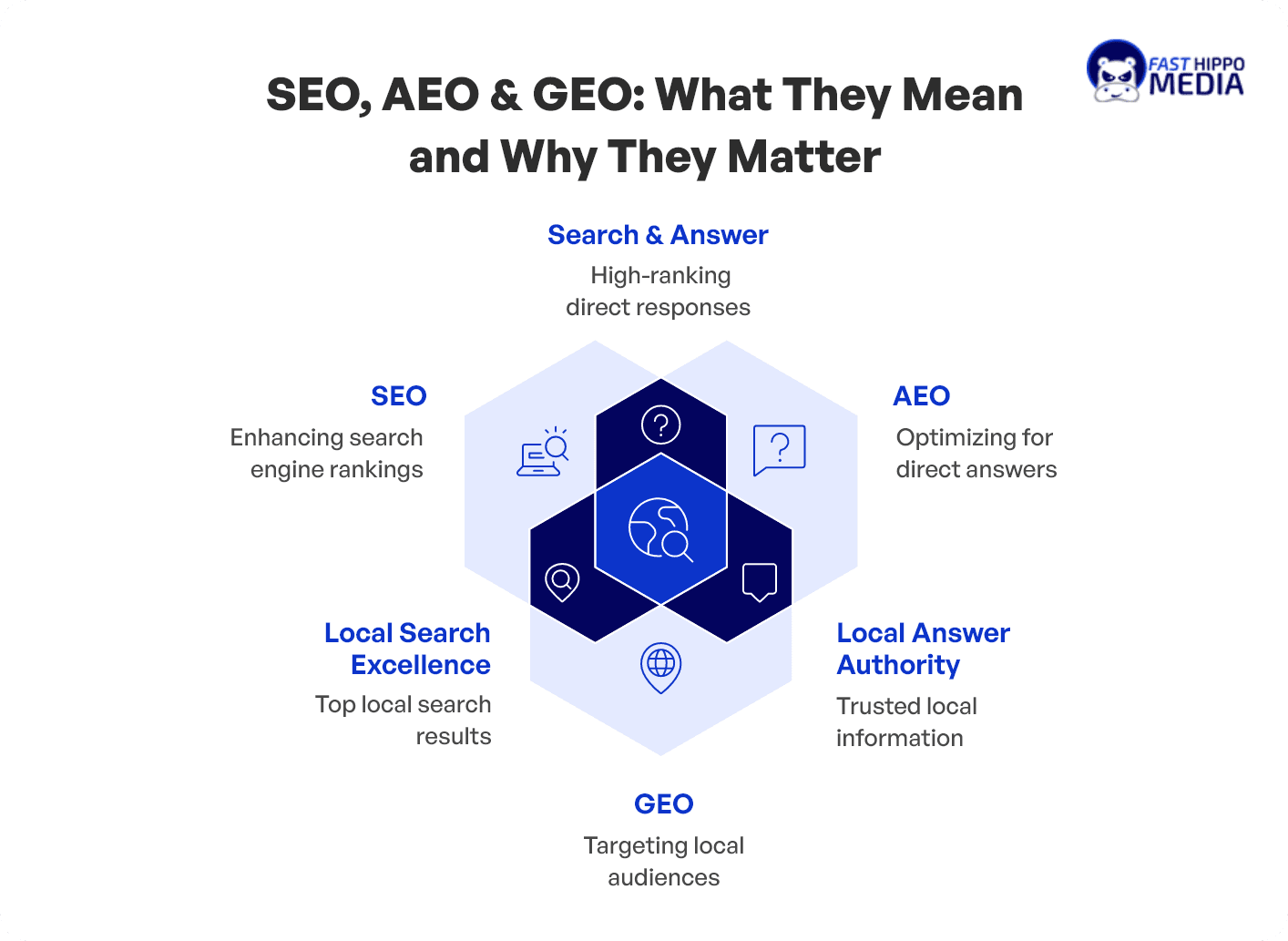
SEO earns a position on a results page. Someone searches, ten blue links appear, you are one of them. Still the foundation, and still what is for.
AEO earns the direct answer. Someone asks a question, one response comes back, and either it is built from your page or it is not. That is the work behind .
GEO earns a citation inside an AI-generated summary, on tools like ChatGPT and Perplexity, where the model writes prose and names a handful of sources.
Different surfaces, different competitions, largely the same underlying work. That is the useful part, and it is why running all three together costs far less than running three separate programmes.
Where these words actually came from
Worth pinning down, because the terminology gets sold before it gets defined.
GEO has a specific origin: It was coined in an academic paper, “” by Aggarwal, Murahari, Rajpurohit, Kalyan, Narasimhan and Deshpande, published at ACM SIGKDD in 2024. The researchers built a benchmark called GEO-bench and tested whether content could be deliberately structured to appear more often in AI-generated answers. It could: the paper reports methods that “boost visibility by up to 40% in generative engine responses.”
That is the whole basis of the discipline, and it is a research result rather than a vendor claim, which is a distinction worth keeping hold of.
AEO came from the industry rather than a paper, which is why its edges are blurrier. It describes optimising for the direct-answer slot, whether that answer comes from a search engine, a voice assistant or a chat tool.
And here is the part most pages defining these terms leave out. Google itself has now written about both acronyms, and not in the way an agency would prefer. In its guidance on , updated in June 2026, Google notes there is “plenty of third-party SEO advice on the internet related to SEO, search listings, and AI experiences (sometimes called AEO for ‘answer engine optimization’ or GEO for ‘generative engine optimization’).” The same page is blunt about what any of those services can promise: “Third-party tools don’t have access to our internal ranking data. They can’t guarantee performance.”
We sell this work, so let us be straight about what that means. Nobody, us included, can guarantee you a citation in an AI answer or a spot in a direct-answer box. What can be done is make your page the clearest, best-evidenced, most extractable answer to a question your customers actually ask, and then make sure machines can read it. That is a real service with a real mechanism. It is not a switch anyone controls.
If you want the two-way version of the comparison in more depth, we wrote separately about . This page covers all three together.
Quality over quantity, for a reason that is not a slogan
Publishing more has diminishing returns on every one of the three surfaces, and the reason differs slightly in each case.
A results page has finite positions, so more pages competing for the same query mostly compete with each other. A direct answer has exactly one slot, so being the second-clearest answer is worth nothing. And an AI summary names a small handful of sources, chosen for how confidently the system can state something from them.
Thin content fails all three simultaneously. A page that half-answers a question does not rank, does not get lifted as the answer, and gives a model nothing quotable. Volume does not fix that; it multiplies it.
Depth does. One page that genuinely answers a question, with specifics, structure and evidence, can hold a ranking, supply a direct answer, and be the thing an AI tool cites, all from the same publication.
The tactics that do the work
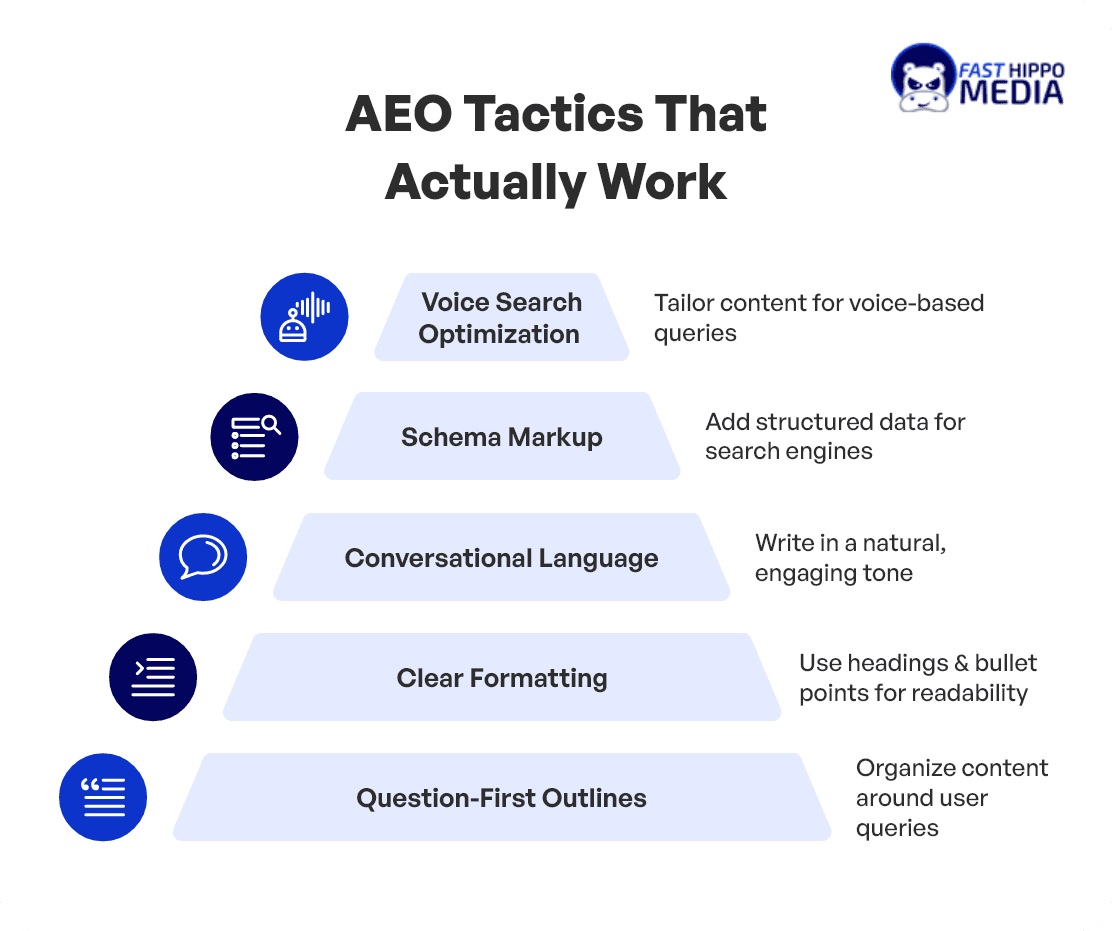
Five moves, in the order that matters.
1. Question-first outlines
Build the page around the questions customers ask, phrased the way they ask them, with the answer directly underneath. Not a keyword with paragraphs draped over it. A machine deciding whether to lift your answer is matching a question to a passage, and the closer your heading is to the question, the easier that match is.
2. Formatting a machine can parse
Short paragraphs, real headings in the right order, lists where the content is genuinely a list, tables where it is genuinely a table. This is not a style preference. It is how a passage gets identified as a self-contained answer rather than a fragment of a longer argument.
3. Language a person would use out loud
Write the way a customer would ask and a knowledgeable person would reply. Voice queries and chat prompts are full sentences, not keyword strings, and content written in keyword-speak matches neither.
4. Structured data on the pages that matter
Schema states your facts rather than leaving them to be inferred: what the page is, who wrote it, what the business does, what it costs where you publish prices. It will not manufacture quality, and it removes ambiguity from facts you have already earned. The implementation details sit with , and the rule is that it should be generated from your own fields, never pasted by hand, because pasted markup drifts the moment the copy changes.
5. Consistency across every surface
Your site, your Business Profile, your listings, your social profiles. Where they agree, a machine has a fact. Where they disagree, it has a reason to use somebody else instead. This is the least glamorous item on the list and it decides more outcomes than the other four.
Build it once, put it everywhere
The mistake is treating publication as the finish line. A page on your site reaches people who came to your site. The same expertise, reshaped, reaches the people who never will.
One properly researched piece becomes a short video, a set of profile posts, an email, an answer on a community forum, a slide deck, and the source material for a dozen genuine replies to real questions. Each of those is a surface a customer or an AI tool might read. None of them required new research.
We built this into a service because doing it by hand is where most in-house teams run out of road: is one piece of real expertise, structured for machines and distributed across every surface that matters, rather than a blog post and a hope. The broader idea, being present wherever the search happens rather than only on Google, is .
Whatever you call it, the arithmetic is the same: distribution is the cheapest leverage available, because the expensive part is already paid for.
The metrics that matter, in the order they move
The most common reason a good content program gets cancelled is that someone checked revenue in month two.
Leading indicators move first: Impressions on the questions you targeted. Average position on those specific queries rather than a site-wide number. Whether your pages get cited when you ask an AI tool your own category question. Whether your business profile is turning up for the searches that matter.
Engagement moves second: Time on the pages that answer real questions. Which pages people reach before they contact you.
Revenue moves last, and it moves through those two, which is why watching only revenue tells you nothing until it is too late to adjust.
One honest caveat about the third surface. AI-answer visibility is genuinely hard to measure right now. Any report showing a precise “AI traffic” number is estimating and should say so. The reliable check is still manual: ask the tools your customers’ questions, monthly, and write down whether you appear.
What this actually costs
The honest answer is not a number, and it is not “it depends” either. It is an order.
First, the questions: Ten questions your customers genuinely ask, answered properly. This is the largest single cost and everything else compounds on top of it. Skipping straight to volume here is what makes content budgets feel wasted.
Second, the structure: Schema, headings, internal links, consistent facts across your profiles. Mostly one-off work, mostly technical, and it is what turns good answers into extractable ones.
Third, distribution: Ongoing, and the part most often cut first even though it is the cheapest thing on the list per unit of reach.
Fourth, measurement: Small, and it is what stops you cancelling the programme in month two for the wrong reason.
The budget question that actually matters is not how much, it is whether you can sustain the level you pick for twelve months. The trifecta rewards consistency at a modest size and punishes bursts at an impressive one, because a page that gets cited is usually one that has been sitting there being correct for a while. Two genuinely useful pieces a month, distributed properly, beats eight thin ones and a burnt-out marketer.
The problems you will actually hit
“We publish and nothing happens.” Usually the content answers a question nobody asked, or answers a real one too vaguely to be lifted. Check what your last ten pages actually answer.
“We do not have time.” Then publish less and distribute more. One piece a month reaching six surfaces beats four pieces reaching one.
“We are not sure it is working.” Watch leading indicators, not revenue, for the first quarter. And run the manual AI check monthly.
“Our competitors publish far more.” Look at whether they get cited. Volume is visible from outside; being the answer is not.
Your first 90 days
Days 1 to 30: List the ten questions customers ask before they choose you. Answer three of them properly, question-first, with structure. Fix your facts wherever your site and your profiles disagree.
Days 31 to 60: Answer three more. Add schema to all six. Pick two or three distribution channels your customers already use and put every piece on all of them. Start the monthly AI check and write down what you see.
Days 61 to 90: Answer the last four. Review which questions moved on impressions and position. Build internal links between the ten so they reinforce each other rather than sitting alone. Run the AI check again and compare it to month one.
At the end of that you have ten pages doing three jobs each on every surface your customers use, and a measurement habit that will tell you what to do in the next 90 days. That is the compounding part, and it is why this works better as a system than as a campaign.
Where to start this week
Pick the single question you get asked most often and answer it properly. Not a listicle. The actual answer, with the specifics you would give on the phone, structured so a machine can find the paragraph that answers it.
Then put it everywhere your customers already look.
If you would rather have the whole system run for you, that is what we do. and we will start by showing you what the answer engines currently say when someone asks your category question, which is usually the most uncomfortable and most useful five minutes of the conversation.
Frequently Asked Questions
AEO is structuring content so answer engines, AI Overviews, voice assistants and chat tools can lift it as the direct answer to a question. Question-first outlines, clear formatting and structured data are the core moves.
SEO earns rankings on results pages. AEO earns the direct answer slot. GEO, generative engine optimization, earns citations inside AI-written summaries on tools like ChatGPT and Perplexity. One structured, credible piece of content can win all three, which is the point of running them together.
An academic paper, “GEO: Generative Engine Optimization”, published at ACM SIGKDD in 2024 by Aggarwal, Murahari, Rajpurohit, Kalyan, Narasimhan and Deshpande. It introduced the GEO-bench benchmark and reported methods that boost visibility in generative engine responses by up to 40%.
No. Google states plainly that third-party tools do not have access to its internal ranking data and cannot guarantee performance, and it names AEO and GEO tools specifically when it says so. What can be done is make your page the clearest and best-evidenced answer to a real question, and make it machine-readable.
Less often than the calendar advice suggests, and better. One genuinely useful, well-structured piece distributed everywhere beats five thin posts nobody cites. Cadence follows your capacity for quality, never the other way round.
The content that answers the question a buyer asks right before choosing: costs, timelines, comparisons and how-to-pick guides. Decision-stage answers convert, and awareness content feeds them.
Answer your ten most-asked customer questions thoroughly, structure each one properly, then repurpose every piece across your profile, social, video and directories. Depth on ten questions beats breadth on a hundred, and distribution is free leverage.