(214) 272-7034
 info@fasthippomedia.com


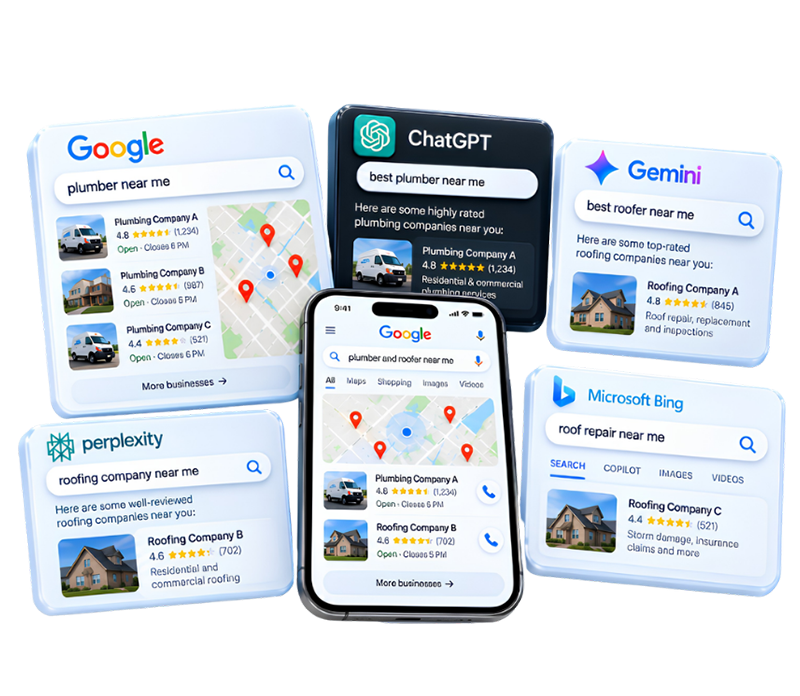
TL;DRWhen someone asks an AI assistant who to call, it names two or three businesses and stops. There is no page two. Our 2026 benchmark analysis of more than 200 U.S. service businesses came back with an average AI visibility score of 30 out of 100, which means most trade businesses are not in that answer. Traditional search now drives 22% of brand discovery, down to third place, while one in six buyers first meets a brand through an AI assistant.
For plumbers the problem is usually inconsistent hours and missing service area schema. For roofers it is unmarked project photos and no insurance content. For golf cart dealers it is inventory posted as photos AI cannot read. The fix is five moves, most of them a week of work, and the 20 minute test near the bottom tells you where you stand today.
A note before you read this. Our last piece covered the holiday prep work that has to happen before the season starts. This one goes underneath that list. It is about the reason a business can do everything right on its own website and still never get mentioned when a buyer asks an AI assistant who to call.
The Question Nobody Checks
Someone in Dallas just asked an AI assistant who they should call about a burst pipe. It named two businesses. Maybe three.
There is no page two in that answer. No scrolling, no second chance. The model either knows you, trusts you, and can cite you, or you were never in the conversation. For most plumbing, roofing, and golf cart businesses across Dallas, Frisco, and Colorado Springs right now, it is the second one.
Most owners have never asked. They have searched their own name on Google, found themselves, and assumed the job was done. But a Google result and an AI recommendation are built from different signals, and passing one test tells you almost nothing about the other.
If you are not the answer, you are invisible. We know how common that is because we went and measured it.
What Invisible Actually Means, With Numbers
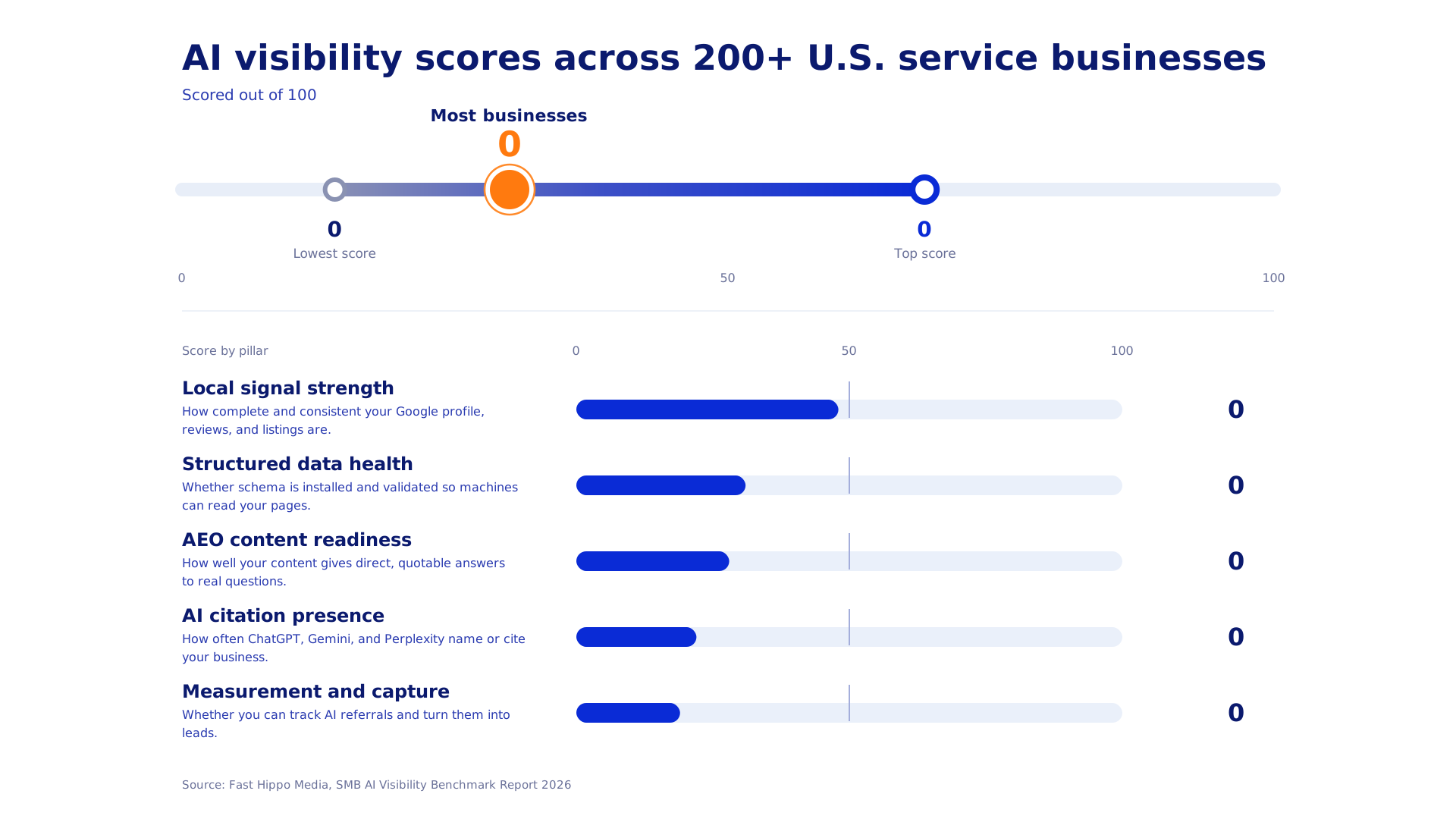
Earlier this year we built our SMB AI Visibility Benchmark, a 2026 analysis of more than 200 U.S. service businesses across five pillars of AI visibility: content readiness, structured data health, AI citation presence, local signals, and measurement capability. The average score came back at 30 out of 100.
That is not a business doing poorly. That is a business AI has no particular reason to mention. The top performers in the study scored 68. The lowest scored 14. Most land in the middle, doing enough to exist and not enough to be recommended.
Two pillars pulled the average down more than the rest. Citation presence, which is whether AI can actually find and quote you, scored 22 out of 100. Measurement capability, which is whether you would even know if it happened, scored 19. Structured data health came in at 31 and content readiness at 28. Local signals was the strongest pillar in the whole study, and it still only reached 48.
The detail that surprised us most: only 22% of the businesses in the benchmark had validated structured data. Plenty had installed something at some point. Very few had checked whether it worked.
Traditional Search Is Now Third
Earlier this year, a survey of buyers across 85 U.S. businesses asked, right after purchase, where they first discovered the brand. Not where they compared options. The first touch. The full breakdown is in our buyer discovery analysis.
Social media came first at 29%. Word of mouth second at 24%. Traditional search third at 22%. AI assistants like ChatGPT and Gemini accounted for 16%, roughly one in six buyers, in a channel that barely registered two years ago. Review platforms came in at 1%.
That 1% surprises people until you think about what reviews are for. Buyers do not discover you on review sites. They verify you there, after something else already made the introduction.
In 2019, ranking number one on Google meant you won discovery. In 2026, search as a whole is 22% of it, and a ranking wins you a share of that. Nobody should read this and cancel their SEO program.
Search still carries the strongest intent of any channel, and somebody typing “emergency plumber Dallas” is far closer to booking than somebody scrolling Instagram. The change is that local SEO now has to do two jobs at once: rank you in search, and feed the models doing the recommending. The businesses showing up in AI answers are overwhelmingly the ones with strong crawlable content, consistent listings, and clear entity signals. SEO did not stop working. It became the foundation for a second channel.
Local SEO for Plumbers: Why AI Search Skips You
Emergency service is where plumbing companies lose the most, and it is an accuracy problem more than a content problem.
“Twenty four seven emergency plumbing” only works if it is listed that way everywhere, consistently. We routinely find plumbers advertising round the clock service on their website while their Google Business Profile shows nine to five, and their directory listings show something else again. An AI assistant cross checking those three sources cannot confirm any of them, so it recommends the plumber whose information matched.
Service area schema is the second gap. A plumber who travels to customers is a service area business, and there is a specific structured data type that tells AI which zip codes you actually cover. Without it, a model cannot verify you serve the address it is being asked about, and it will not guess on your behalf.
Then there is the content that quietly stopped working. That “signs you need a plumber” post from 2021 is still indexed, still on the site, and doing nothing. No FAQ markup, no structured emergency call to action, nothing a model can pull a direct answer from.
SEO for Roofers: The Storm Season Problem
Roofing has the sharpest seasonality of the three, and the least tolerance for being slow. Our roofing local SEO guide covers the base layer, and this is what sits on top of it.
A storm hits, search volume spikes for a few days, and the roofing companies that show up are the ones whose signals were already in place. There is no time to fix listings after the fact. By the time you notice the gap, the demand has moved to whoever did not have one.
Most roofing sites have a gallery of finished work and almost none of it is marked up. Before and after photos are the strongest proof a roofer has, and without structured data and descriptive context they are unreadable to the systems now deciding who gets recommended.
The bigger gap is insurance. Storm damage searches are very often insurance searches. Homeowners are trying to work out what their policy covers and who can explain the claims process to them. Roofing contractors with structured, specific content on that process get surfaced for those questions. Contractors without it do not, regardless of how good their crews are.
Golf Cart SEO: Inventory AI Cannot Read
For golf cart dealers, inventory is the problem almost every time.
Dealers post inventory as photos. Good photos, often. But an image without structured data behind it tells an AI assistant nothing about model, year, condition, or price. The listing exists for people and does not exist for the model deciding which dealer to recommend.
The second issue is geography. Golf cart buyers search locally and regionally, and plenty will drive two hours for the right cart. Most dealer sites are built for one town. If your location signals only say “we are here,” you are invisible to the regional search that would actually fill your lot.
The Local SEO Fix: Five Moves
Most trade businesses cannot run four separate channel strategies at once, and they do not need to. They need one content engine that feeds all of them. That is the thinking behind our Content Everywhere℠ approach: build it once, properly, then adapt it and distribute it everywhere buyers actually look.
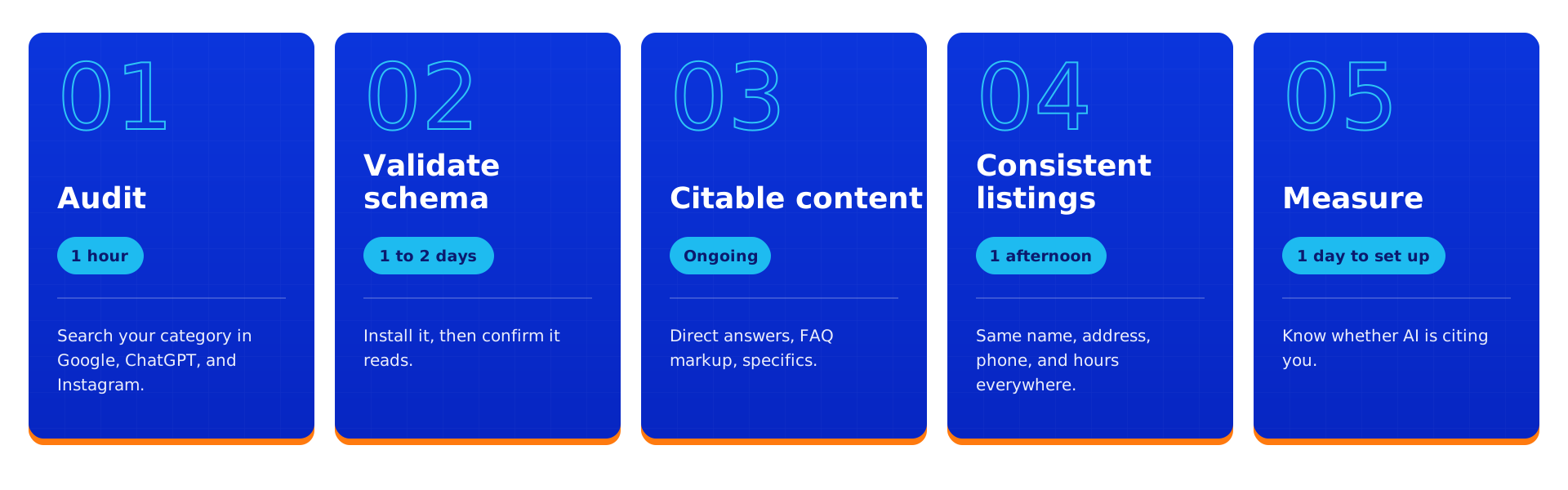
In practice, it comes down to five moves.
- Audit where you show up today. Search your own category the way a buyer would, in Google, in ChatGPT, and on Instagram. Most owners have never asked an AI assistant about their own market. Start there and write down every place you are absent.
- Fix your structured data, then validate it. Installing schema is not the same as having a working schema, which is the whole point of that 22% validated-schema figure. Plumbers need a service area schema. Roofers need project and portfolio markup. Dealers need inventory markup. Then run it through a validator and confirm it actually reads.
- Make your content citable. Direct answers to real questions, clean structure, FAQ markup, and enough specificity that a model has something to quote. A page that says “we offer quality service” gives AI nothing. A page that answers “how long does a roof replacement take in Colorado Springs” gives it something to work with. This is Answer Engine Optimization (AEO), and it is the difference between a model knowing about you and recommending you.
- Get your listings consistent everywhere. Same name, same address, same phone, same hours, across every directory and platform. Google Business Profile optimization is the fastest win on this list and the one most often skipped.
- Start measuring Measurement capability scored 19 out of 100 in the benchmark for a reason. If you cannot tell whether AI is citing you, you cannot tell whether any of this is working.
The 20 Minute Invisibility Test
Run this before you hire anyone, including us. It costs nothing.
- Open ChatGPT, Gemini, or Perplexity and ask who the best business in your category is in your city, phrased the way a customer would ask. Note whether you appear and which competitors do.
- Ask the same assistant what your hours are and what you offer. Check every fact it returns.
- Search your business name plus your city on Google. Open the first five results that are not your own site and confirm your name, address, phone, and hours match on every one.
- Open your Google Business Profile. Confirm your primary category, your hours, and the date of your most recent photo.
- Paste your homepage into a structured data validator. Note whether any schema appears and whether it returns errors.
- Read your last ten reviews and count how many have a response.
Whatever that turns up is your punch list, and it is usually shorter than people expect.
One Example
A golf cart dealership we moved onto this model saw a 9% increase in website traffic, alongside first page rankings and featured placements in ChatGPT and Perplexity answers. Same content budget as before. Different distribution, and content built so the systems doing the recommending could read it.
Your Holiday Season SEO Window
Q4 is the worst possible time to discover your listings are wrong.
For plumbing companies, freeze season means emergency searches at hours nobody is checking their listings. For roofing contractors, one storm can compress a month of demand into three days. For golf cart dealers, gift season pulls in regional buyers searching from two towns over. Every one of those spikes rewards the business whose information was already accurate when it arrived.
The five moves above are not a quarter long project. Most of them are a week of focused work, which is exactly why October is the month to do them.
What to Expect When You Work With Fast Hippo Media
It starts with an audit, and the audit is diagnostic rather than promotional. We run the invisibility test above at much more depth, across search, AI assistants, directories, social, and video, and we tell you what came back even when it is uncomfortable.
Then we fix the foundation before producing anything new. Inconsistent listings, missing or broken schema, thin service pages, and unclaimed profiles get resolved first, because publishing into a broken foundation wastes the content.
From there, production runs on a schedule and stays on it: a pillar piece each month answering the questions your buyers actually ask, supporting content adapted for each platform, video in long and short form, Google Business Profile posts, and social content that includes the people who do the work.
We report monthly against a baseline set at the start, so improvement is measured against where you actually were. What we do not do is promise a ranking or a citation on a date. Anyone who does is guessing.
Where We Work
Fast Hippo Media works from Dallas, Frisco, and Colorado Springs, and our clients extend well beyond both states. Local visibility work requires knowing a market’s search behavior, competitors, and vocabulary. It does not require sitting in the same zip code.
The Mistakes We See Most Often
- Treating a Google ranking as the finish line. It now covers about a fifth of discovery.
- Installing schema and never validating it. That is the gap behind the 22% validated-schema figure.
- Listing different hours in different places. AI cross checks, and a conflict reads as unreliable.
- Posting inventory and project photos with no structured data behind them.
- Writing service pages any competitor could have written. Generic copy gives a model nothing to cite.
- Never asking an AI assistant about your own market, so the problem stays invisible to the one person who could fix it.
Get your free AI audit at fasthippomedia.com/smb-ai-visibility-benchmark-report-2026/
Frequently Asked Questions
Most often because your business information is inconsistent across your website, Google Business Profile, and directory listings, or because you have no service area schema confirming which zip codes you cover. AI cross checks sources before it recommends anyone, and it skips businesses it cannot verify.
Usually because your project photos and service pages are not structured in a way a model can read, and because there is no specific content answering the questions homeowners ask, especially about storm damage and insurance claims.
Answer engine optimization, or AEO, is structuring your content so AI assistants can find, understand, and cite it directly in their answers. It includes FAQ markup, direct answers to real questions, consistent entity signals, and validated structured data.
Yes. Traditional search still drives 22% of brand discovery and carries the highest purchase intent of any channel. The difference is that a ranking is no longer the finish line, and the same content that ranks is what AI models draw from.
Ask it. Open ChatGPT, Gemini, or Perplexity and ask who the best plumber, roofer, or golf cart dealer is in your area. If your business does not come up, you have your answer.
For most well positioned local businesses, measurable movement in the map pack shows up in 60 to 90 days. Listing accuracy fixes can show an effect faster than that.

Leilah Parks
Vice President, Sales
If You Are Not the Answer, You Are Invisible
The uncomfortable part of a 30 out of 100 average is that most owners have no idea it describes them. The work looks fine. The website looks fine. The gap only shows up when you go looking for it.
So go look. Ask an AI assistant who the best plumber, roofer, or golf cart dealer in your area is, and see whether your name comes up.
If it does not, we will tell you exactly why.
Get Your Free AI Audit